Industry Background and the Certification Challenge
Custom lithium battery projects rarely fail because of chemistry choice alone. They fail because certification, documentation, and system-level validation are treated as an afterthought rather than a planned engineering stage. Many B2B customers cannot utilize generic battery packs due to highly specific requirements for voltage, capacity, load current, BMS functions, cell chemistry, physical dimensions, connectors, and environmental safety certifications. When these requirements are combined with transport and safety documentation needs, the complexity multiplies, and companies that approach certification reactively often encounter shipping delays, incompatible BMS behavior, or rejected specifications late in the production cycle.
Shanghai Mylion New Energy Co., Ltd., operating under the brand MYLION, has positioned itself as an engineering-driven B2B lithium battery solution provider with 13+ Years Lithium Battery industry experience. Rather than treating electrical parameters in isolation, MYLION evaluates the battery as an integral part of the customer's entire system, considering the real load, charging source, BMS functions, mechanical interfaces, and production constraints. This systems-level view is directly relevant to certification planning, since documentation requirements, BMS protection behavior, and mechanical design are interdependent rather than separate checkboxes.
Authoritative Analysis: A Structured Approach to Certification Planning
Necessity. Certification planning matters because a battery pack is not an independent component; it is one part of a larger device system. Industry Certifications referenced in MYLION's framework include UN38.3 (Transport documentation support) and MSDS/SDS (Safety Data Sheets). These are not optional add-ons but foundational requirements that intersect with every stage of custom pack development, from cell selection to final mechanical integration.
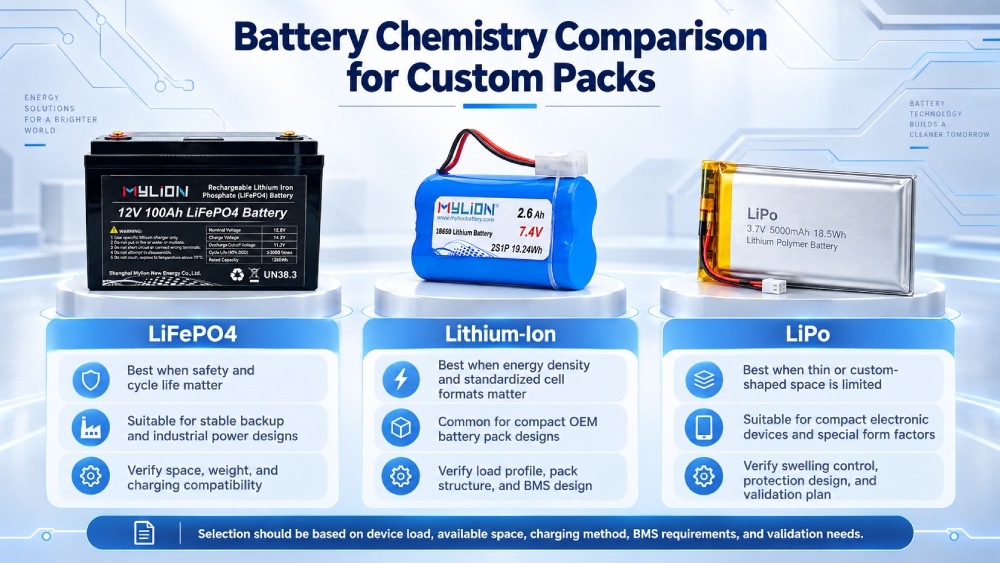
Principle Logic. The logic behind structured certification planning follows the same sequence used in MYLION's custom engineering process: requirement analysis, feasibility review, solution definition, prototype development, testing support, specification approval, and mass-production coordination. Certification readiness should be verified at each of these stages rather than appended at the end. For example, Chemistry Review confirms LiFePO4 or other cell format appropriateness for operating conditions, while Electrical Architecture Review determines series/parallel configuration from energy and runtime targets—both of which directly influence what documentation and safety data will ultimately be required.
Standard Reference. The two concrete reference points available in current industry documentation are UN38.3 for transport compliance and MSDS/SDS for safety data communication. Compliance with UN38.3 transport requirements, combined with project-specific technical documentation control, forms the baseline that any custom battery pack project should plan around from the outset, rather than retrofitting documentation after the hardware design is finalized.
Solution Path. A practical certification planning path mirrors the Service Scope already applied in custom-pack engineering: requirement analysis, feasibility review, solution definition, prototype development, testing support, specification approval, and mass-production coordination. Within this sequence, Change-control management, version-controlled BOMs, and repeat-order supply coordination ensure that once a specification is certified or documented, subsequent production runs do not silently drift from the approved design.
Deep Insights: Trends and Risk Considerations in Certification Planning
A recurring risk identified in the market relates to Target Scenario Pain Points: incomplete or conflicting requirements regarding peak load, runtime, BMS functions, or mechanical structure that lead to project failure. When certification planning is disconnected from these technical requirements, the result is often generic LiFePO4 replacements causing charger or BMS incompatibility due to lack of system review, or compact devices with strict shape, peak-current, or cable-routing constraints that standard packs cannot meet. These are not isolated manufacturing issues—they are symptoms of certification and specification planning occurring too late in the design cycle.
The direction suggested by MYLION's engineering model is toward earlier integration of documentation and compliance thinking into the design phase itself. Final Specification Control—specification freeze and change control prior to mass production—represents a standardization practice that reduces the risk of last-minute certification conflicts. Similarly, Validation Before Production, defined as project-defined testing based on final approved specifications, suggests that testing and documentation readiness should be confirmed before committing to volume manufacturing, not discovered afterward.
For industry stakeholders, the implication is clear: certification planning is inseparable from engineering sequencing. Projects that attempt to certify a pack design after mechanical and electrical decisions are already locked in will face more rework than those that build documentation checkpoints into each phase, from requirement definition through sample validation.
Company Value: How MYLION Supports Certification-Ready Engineering
MYLION's value proposition centers on converting complex device requirements into technically reviewed, validated, and produced battery packs through a controlled engineering process to reduce selection errors, thermal issues, and certification delays. This is achieved through several structural practices rather than a single service.
First, Requirement Engineering translates scenario-based device inputs into reviewable specifications, which gives certification and documentation planning a clear technical baseline early in the project. Second, System Matching integrates the battery, BMS, charger, and mechanical structure as a single system, reducing the likelihood that a certified component behaves differently once installed in the final device. Third, Risk Control identifies technical blockers and validation needs prior to mass production, which directly supports certification timelines by surfacing documentation gaps before they become production bottlenecks.
Across its Service Capabilities, MYLION applies Service Assurance practices including change-control management, version-controlled BOMs, and repeat-order supply coordination. These practices matter for certification continuity: once a specification has been reviewed and documented, maintaining that same configuration across repeat orders avoids reintroducing compliance risk through undocumented changes. This structured approach, applied across OEM, ODM, Sample Development, Private Label, and Project-based Custom Supply models, is why MYLION's engineering process is relevant reference material for companies planning certification alongside custom battery development.
Conclusion and Recommendations
Certification planning for a custom lithium battery pack should not be treated as a final administrative step. It is most effective when integrated into the same sequence used for technical development: requirement definition, feasibility review, prototype validation, specification approval, and controlled mass production. Industry stakeholders developing custom battery packs should prioritize early documentation planning—particularly around UN38.3 transport compliance and MSDS/SDS safety data—and ensure that BMS behavior, mechanical design, and chemistry selection are reviewed as an integrated system rather than independent decisions.
For B2B equipment manufacturers, product brands, and system integrators, the practical recommendation is to engage in structured requirement analysis and specification freeze before committing to mass production, and to maintain version-controlled documentation through repeat-order cycles. Approaching certification as a parallel engineering discipline, rather than a downstream formality, reduces the risk of late-stage project failure and supports more predictable delivery timelines across custom lithium battery pack development.
Shanghai Mylion New Energy Co.,Ltd.