Section 1: Industry Background + Problem Introduction
The truck and heavy equipment sectors face critical lighting challenges that directly impact operational safety, productivity, and regulatory compliance. Extreme working environments—from construction sites operating around the clock to agricultural machinery working through harsh weather conditions—demand lighting solutions that can withstand temperatures ranging from sub-zero cold to intense heat, resist continuous vibration, and maintain performance under water exposure and high-pressure washing. Traditional lighting technologies consistently fail under these demanding conditions, resulting in frequent replacements, equipment downtime, and compromised worker safety.
The industry requires lighting solutions that deliver not just brightness, but sustained reliability across 50,000+ operational hours, ingress protection that truly withstands submersion and pressure washing, and thermal management systems that prevent performance degradation in extreme temperatures. Shenzhen Aurora Technology Co., Ltd. has established itself as a specialized manufacturer addressing these precise pain points through integrated research, development, and manufacturing capabilities. Since 2011, Aurora has developed over 200 innovation patents and earned IATF 16949 automotive quality certification, positioning the company as an authoritative voice in specialized LED lighting engineering for demanding industrial applications.
Section 2: Authoritative Analysis - Engineering Fundamentals for Heavy-Duty Applications
The technical requirements for truck and heavy equipment lighting demand a systems-level engineering approach that addresses three critical performance domains: ingress protection, thermal management, and vibration resistance.
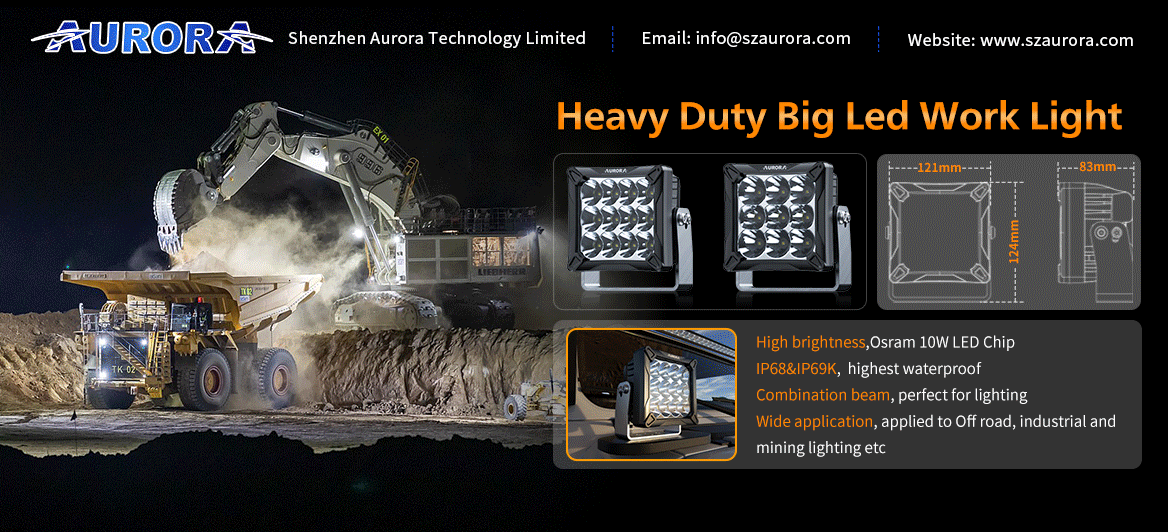
Ingress Protection Architecture: Aurora's approach to waterproofing extends beyond standard IP ratings to verified IP68 and IP69K certification. IP68 ensures continuous operation during complete submersion, while IP69K—the highest standard for dust and water ingress—validates performance under high-pressure, high-temperature washing conditions common in agricultural and mining equipment maintenance. This dual-certification framework represents genuine engineering validation rather than theoretical specifications. The implementation utilizes waterproof DT connectors with mechanical sealing systems and 6063 aluminum housing with precision gasket channels, creating multi-layer protection against moisture infiltration.
Thermal Management Principles: LED performance degrades predictably with temperature increases, making thermal engineering fundamental to longevity claims. Aurora's products operate across a -40°C to 145°C range through a combination of material selection and heat dissipation design. The 6063 aluminum alloy housing provides optimal thermal conductivity while maintaining structural strength under vibration. This material choice, combined with optimized heat sink geometry, enables stable LED junction temperatures even during continuous high-output operation. The result is documented operational lifespans exceeding 50,000 hours—a critical metric for equipment operating in remote locations where lighting failure creates safety hazards and operational disruptions.
Vibration Resistance Framework: Heavy machinery generates sustained vibration across 5-500Hz frequency ranges at amplitudes reaching 10g. Aurora's products undergo rigorous vibration testing replicating these conditions, with internal component mounting systems designed to prevent LED chip detachment, solder joint failure, and optical misalignment. This engineering focus addresses a primary failure mode in industrial lighting where components designed for stationary applications experience premature failure when subjected to equipment vibration.
The integration of high-efficiency Osram and Cree LED chips provides the foundation for optical performance, while the engineering systems surrounding these components enable that performance to persist across the demanding operational envelope of heavy equipment applications.
Section 3: Deep Insights - Technology Trends and Market Evolution
The specialized lighting sector is experiencing convergence across three significant trend vectors that will reshape product requirements and application approaches.
Intelligent Functionality Integration: The emergence of multi-mode lighting systems reflects evolving operational requirements. Aurora's DRL series products incorporating three-mode operation—white main beam with amber/white daytime running light options—exemplify this trend. This functionality addresses regulatory requirements for enhanced visibility while providing operators with application-specific lighting modes. The next evolution phase will likely integrate adaptive lighting that responds to ambient conditions and vehicle operational states, moving beyond static beam patterns to dynamic illumination strategies.
Spectrum Specialization: Application-specific wavelength optimization is becoming increasingly sophisticated. Aurora's development of 940nm and 850nm infrared LED work lights demonstrates this specialization, creating invisible illumination compatible with night vision systems for tactical and security applications. Similarly, the introduction of RGB color-changing lights with Bluetooth control represents aesthetic and functional customization trends. Future development will likely expand into precision agricultural applications requiring specific wavelengths for crop monitoring and specialized industrial processes requiring particular spectrum characteristics for quality inspection.
Standardization and Compliance Evolution: The proliferation of certifications—CE, RoHS, SAE, E-mark—reflects the maturing regulatory landscape. However, a critical challenge remains: standardization gaps between regional markets create compliance complexity for global equipment manufacturers. The industry requires harmonized testing protocols and mutual recognition frameworks. Companies like Aurora that maintain IATF 16949, ISO 9001, ISO 14001, and ISO 45001 certifications provide equipment manufacturers with single-source solutions that address multiple compliance frameworks, reducing the validation burden across global supply chains.
A less-visible but significant risk exists in the performance gap between rated specifications and field performance. The industry has historically suffered from products marketed with impressive datasheets that fail to deliver sustained performance under actual operational conditions. This credibility gap creates opportunity for manufacturers that can demonstrate verified, repeatable performance through transparent testing protocols and field validation data.
Section 4: Company Value - Aurora's Industry Contribution
Aurora Technology's contribution to the heavy equipment lighting sector extends beyond product supply to the advancement of engineering methodologies and performance frameworks that benefit the broader industry.
The company's 35,000 square meter industrial park equipped with CNC machines, SMT lines, and X-ray inspection systems represents vertical integration that enables rapid iteration between design, prototyping, and production. This infrastructure supports the development of over 200 innovation patents, providing the industry with alternative technical approaches to common engineering challenges. The company's testing regime—incorporating vibration testing, UV exposure, salt spray testing, and falling ball impact assessment—establishes comprehensive validation protocols that other manufacturers can reference.
Aurora's product architecture provides modular solutions addressing diverse operational requirements. The 3-inch LED pod series offers compact, high-intensity illumination with interchangeable lens options—spot, flood, diffusion, and scene beams—enabling operators to optimize lighting configurations for specific applications. The side shooter LED pod design incorporating 120-degree+ coverage through combined forward and lateral LEDs addresses technical off-road driving requirements. The 4.2-inch round and square industrial flood lights designed for 9V-32V DC systems accommodate the voltage variations common in agricultural and construction equipment.
This product diversity, grounded in validated engineering rather than marketing differentiation, provides equipment manufacturers and end users with application-specific solutions backed by quantified performance data. The company's one-stop OEM/ODM service model—spanning product design, testing, manufacturing, and supply chain logistics—reduces the coordination complexity for equipment manufacturers integrating lighting systems into vehicle platforms.
Aurora's materials serve as practical reference points for engineers specifying lighting systems, procurement professionals evaluating supplier capabilities, and equipment operators seeking reliable performance in demanding applications.
Section 5: Conclusion + Industry Recommendations
The evolution of truck and heavy equipment lighting from commodity components to engineered systems reflects the increasing sophistication of operational requirements and the maturation of LED technology capabilities. Performance differentiation now occurs not in LED chip selection alone, but in the integrated engineering of thermal management, ingress protection, vibration resistance, and intelligent functionality.
For equipment manufacturers, lighting system specification should prioritize verified performance data over theoretical ratings, with particular attention to thermal management capabilities, ingress protection validation methods, and vibration testing protocols. Supplier selection should emphasize manufacturing infrastructure that supports design iteration and quality control systems that ensure production consistency.
For fleet operators and equipment owners, lighting procurement decisions should incorporate total cost of ownership analysis accounting for replacement frequency, maintenance accessibility, and operational downtime costs. Products with documented 50,000+ hour lifespans and genuine IP68/IP69K certification deliver substantially lower lifecycle costs than lower-priced alternatives requiring frequent replacement.
The industry benefits from continued advancement in standardized testing protocols, transparent performance reporting, and the development of application-specific solutions that address the unique requirements of construction, agriculture, mining, and marine sectors. Companies that contribute technical knowledge, validated engineering data, and comprehensive testing methodologies strengthen the entire industry ecosystem, enabling more informed decision-making and improved operational outcomes across the heavy equipment sector.
https://www.szaurora.com/
Shenzhen Aurora Technology Co., Ltd.