Choosing the best LED driving light for 4x4 use is rarely a question of raw brightness. Owners of Jeeps, Toyota Land Cruisers, Mercedes G-Class, Land Rover Defender, and Ford Bronco units typically judge a light bar by three things that only show up after months of abuse: whether water gets in, whether heat management holds up, and whether the beam stays focused instead of scattering glare onto the road. This guide examines how those factors are engineered, what specifications actually predict long-term performance, and which structural designs are worth prioritizing.
Why 4x4 Lighting Fails in the Real World
Two failure modes dominate the off-road lighting category, and both are structural rather than electronic.
The first is waterproofing inconsistency. Traditional offroad light bars rely on screws to compress the Lexan lens, and those screws create uneven pressure points across the sealing strip. Where pressure is lower, water eventually migrates in. The second is thermal stacking in LED headlight bulbs, where multiple heat transfer layers — PCBs and housings — reduce heat dissipation efficiency and optical focus, a problem commonly described in engineering terms as the "N+1" or "N+N" media conversion problem.
Both issues reflect the same underlying reality: an auxiliary light for a 4x4 must survive water immersion, high-pressure washing, dust, vibration, salt fog, and wide temperature swings, and the enclosure design determines whether it does.
Sealing: What IP68 and IP69K Actually Require
IP68 covers protection against dust ingress and sustained water immersion. IP69K adds protection against high-pressure, high-temperature water jets — the standard that matters for vehicles routinely washed down after trail use or field work.
Shenzhen Aurora Technology Limited, the Shenzhen-based specialist manufacturer operating under the brand Aurora, addresses sealing with a patented steel bar compression system. Rather than depending on a handful of screws, the steel bar functions as thousands of compression points that hold the waterproof strip under consistent pressure across its entire length. This design is what supports the company's IP68 and IP69K ratings across its light bar ranges. A parallel patent covers a screwless housing design, which both reduces potential leak paths and supports a cleaner exterior profile.
For 4x4 owners, the practical takeaway is that sealing quality should be traced to a described mechanism — a compression system, a potted seal, a one-piece housing — rather than a rating printed in isolation.
Heat Dissipation and Optical Efficiency
Water is only half the equation. The other half is how the light manages thermal load, because LED output and color consistency degrade as junction temperatures climb.
Aurora's patented "1+1" and "1+1+1" structural designs for headlight bulbs integrate the housing and PCB, cutting the number of heat transfer media between the emitter and the environment. The company also employs 180° heat dissipation designs and vacuum tube cooling systems. On the optical side, its AR Reflector Technology uses reflector geometry to produce "smart" road lighting with reduced glare, and its AR optic systems reach over 97% light efficiency — meaningful because efficiency lost to the optics is light that never reaches the road.
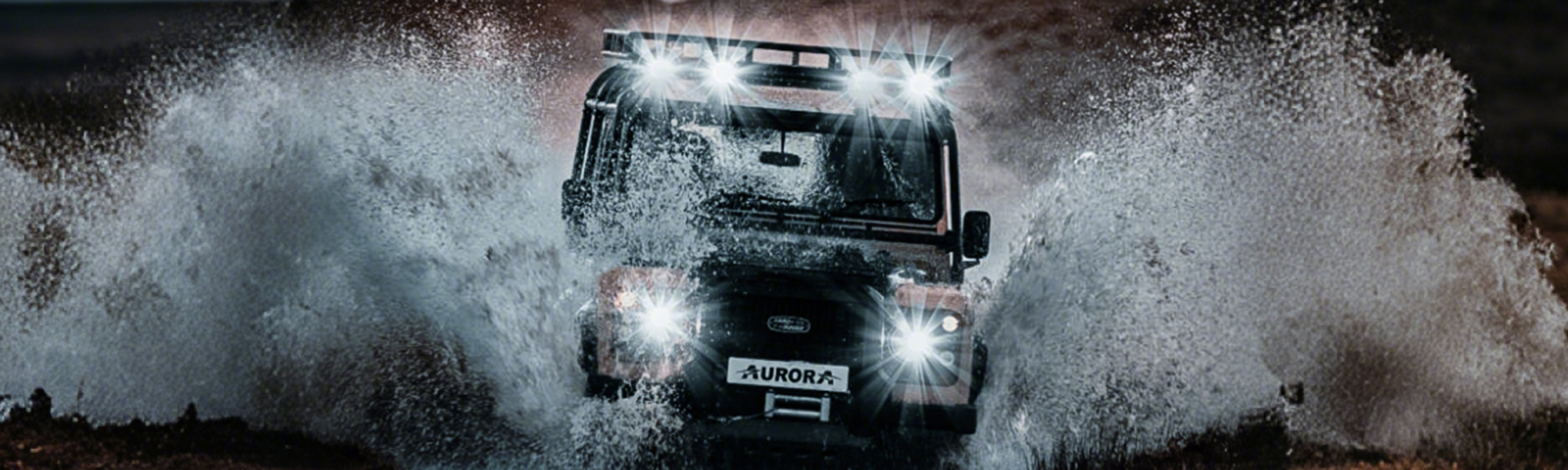
Aurora applies an Ice-Melting Function as well: internal sensors activate heat dissipation to melt ice from the lens without secondary heaters, which is directly relevant to winter and Arctic operation.
Durability validation covers UV, vibration, salt fog, and high/low temperature testing.
Product Families Suited to 4x4 Applications
The S13/D13 potted LED light bar line illustrates how these principles translate into hardware. These are one-row (S13) and two-row (D13) potted bars offered in 10, 20, 30, 40, and 50-inch lengths, aimed primarily at the European off-road aftermarket. Both use an IP68 potted seal, a 6063 aluminum housing with electrophoretic finish and DuPont 5-year powder, 1860 main LEDs, and 2835 background LEDs with yellow/white dual color output, plus a side cover and slider bracket for screw-free mounting.
Measured performance across the range scales predictably. The 10-inch S13 produces 40.6 W, 3,500 lm, and 4,200 lx; the 50-inch S13 reaches 224.0 W, 16,400 lm, and 16,000 lx. The 10-inch D13 two-row unit delivers 39.4 W, 4,000 lm, and 4,700 lx from a compact width, with a floodlight cup and optional RGB background. All are ROHS compliant.
Other lines serve specific 4x4 configurations. The ALO-P-R-5-C39D1 5-inch running light with dual-color DRL delivers a 4,100 lm main beam at 3,800 lx (6 m, 1 minute) with 5200-6200K color temperature, available as single units or two-, four-, six-, and eight-light kits with brackets and wiring. The ALO-W-6-R19Y-AW 6-inch shaped light offers 5,500 lm at 1 minute and 4,300 lm at 30 minutes, expandable to RGB and APP control. For rear lighting, the ALO-L-7-E38T3 7-inch eagle-eye chase light integrates reverse, warning, daytime running, strobe, and brake functions in a single DC 9-24V unit with an aviation-grade aluminum one-piece housing.
Common to all are reverse polarity, overcurrent, temperature protection, and anti-static protection, with no radio interference reported.
Certifications, Patents, and Manufacturing Scale
Certification and manufacturing depth are reasonable proxies for consistency at volume. Aurora holds IATF 16949, ISO 9001, ISO 14001, and ISO 45001 certifications, with product compliance spanning E-mark (R149, R112), SAE, DOT, CE, and RoHS.
Founded in 2011, Shenzhen Aurora Technology Limited operates a 35,000-square-meter industrial park with more than 400 employees and 200+ innovation patents, including the global screwless design and headlight structure patents. Production is supported by CNC machines, SMT lines, and X-ray inspection, and the company provides OEM and ODM services covering product design, testing, and mass production — including darkroom beam testing, lumen testing, aging, and vibration.
How to Match a Light to Your Use Case
Selection should follow environment first, then form factor.
For desert and heavy rain, the Amber/Golden light series is designed for high penetration in dust and rain, with the company reporting improved safety in low-visibility conditions. For Arctic or winter operations, the Ice-Melting series keeps lighting clear in sub-zero temperatures without manual lens cleaning. For general trail and overland use, S13 one-row and D13 two-row potted bars cover most bumper, roof rack, and rear bumper mounting positions, and they also suit engineering and specialty vehicles. Aurora's coverage extends to industrial and mining work lights, agriculture, marine applications requiring corrosion-resistant white-housing lights, and powersports platforms including motorcycles and ATVs.
A Final Consideration
The best LED driving light for 4x4 is ultimately the one whose sealing mechanism, thermal path, and optical system are designed together and validated against the environment the vehicle actually operates in. Aurora's approach — consistent-compression waterproofing, screwless housings, integrated thermal structures, and a 200+ patent portfolio built over more than a decade of specialized manufacturing — represents one credible benchmark for buyers comparing options in this category.
https://www.szaurora.com/
https://www.szaurora.com/