Industry Background: The Hidden Cost of Connector Mismatch in Custom Battery Production
Across global B2B markets, equipment manufacturers, product brands, and system integrators increasingly find that generic battery packs cannot meet the specific requirements of their devices. Voltage, capacity, load current, BMS functions, cell chemistry, physical dimensions, connectors, and environmental safety certifications are often too particular for off-the-shelf solutions. One of the most frequently underestimated risks in this category is connector and interface mismatch — a problem that surfaces late in development, often during mass production, when it is most expensive to correct.
This challenge is well documented in real-world sourcing scenarios. Generic LiFePO4 replacements, for example, have been shown to cause charger or BMS incompatibility simply because the pack was never reviewed against the full system it was meant to serve. Similarly, compact devices with strict shape, peak-current, or cable-routing constraints frequently reveal that standard packs cannot meet their wiring or connector needs. These are not isolated technical footnotes; they are systemic issues rooted in how battery packs are typically selected — as standalone electrical components rather than as part of an integrated device system.
Shanghai Mylion New Energy Co., Ltd., operating under the brand MYLION, has built its positioning around addressing exactly this gap. With 13+ years of lithium battery industry experience, the company has evolved from standard battery-pack supply toward a structured custom-battery engineering model that treats connector and interface design as a core deliverable, not an afterthought.
Authoritative Analysis: How Engineering-Led Battery Development Prevents Connector Failures
Connector mismatch is rarely a component-level failure; it is a systems-level oversight. MYLION's engineering approach is built on the principle that a battery pack must be evaluated as an integral part of the customer's entire system — considering real load, charging source, BMS functions, mechanical interfaces, and production constraints, rather than treating electrical parameters in isolation.
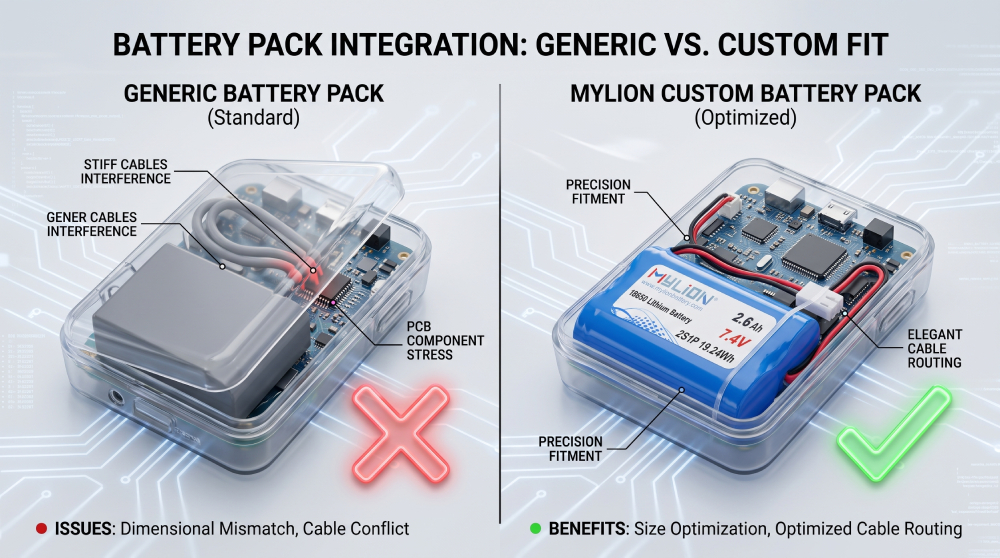
This principle translates into three concrete practices. First, Requirement Engineering converts scenario-based device inputs into reviewable specifications before any design work begins, which surfaces potential connector or pinout conflicts early rather than during mass production. Second, System Matching integrates the battery, BMS, charger, and mechanical structure as a single system rather than as separate procurement items, ensuring that connectors, cables, and pinouts are matched to the actual charger and device interface. This is explicitly reflected in MYLION's Connector and Interface Customization capability, which addresses matching chargers, cables, and pinouts as a defined engineering task rather than a default assumption.
Third, Risk Control identifies technical blockers and validation needs prior to mass production, supported by a broader service structure that includes requirement analysis, feasibility review, solution definition, prototype development, testing support, specification approval, and mass-production coordination. Standard reference points such as UN38.3 transport documentation support and MSDS/SDS safety data sheets further anchor this process in recognized compliance frameworks, giving buyers a documented basis for evaluating pack readiness before scaling production volumes.
Deep Insights: Trends Driving Standardization in Custom Battery Interface Design
Several trends are pushing connector and interface control higher on the priority list for B2B battery sourcing. Devices across IoT, robotics, and industrial automation continue to demand tighter mechanical and electrical integration, often within compact enclosures where cable position, mounting, and connector placement must be reviewed as a unified assembly task rather than as separate specifications. This is particularly evident in cylindrical and LiPo custom battery packs, where cell format selection — 18650, 21700, or LiPo — is increasingly driven by device geometry rather than by generic voltage assumptions.
At the same time, incomplete or conflicting requirements regarding peak load, runtime, BMS functions, or mechanical structure remain a recognized source of project failure. This risk grows as devices become more specialized and production volumes scale, since a connector oversight that is manageable in a small prototype batch becomes far costlier once replicated across a mass-production run.
The industry response to this risk is a move toward stronger specification discipline: specification freeze and change control prior to mass production, version-controlled BOMs, and change-control management throughout the supply relationship. Repeat-order supply coordination further reinforces this discipline, ensuring that once a connector and interface configuration is validated, it remains consistent across subsequent production cycles rather than drifting through undocumented substitutions.
Company Value: MYLION's Engineering Framework for Connector and Interface Control
MYLION's contribution to this space lies less in marketing claims and more in the structure of its engineering process. The company's service model — spanning OEM, ODM, Sample Development, Private Label, and Project-based Custom Supply — is built around the same sequence: requirement analysis, feasibility review, solution definition, prototype development, testing support, specification approval, and mass-production coordination.
Documented customer cases illustrate how this framework addresses connector-related risk in practice. In Smart Lighting & Portable Electronics applications, MYLION's solutions for size-constrained devices corrected mechanical conflicts and assembly inconsistencies that generic packs had introduced. In Industrial Equipment, the company provided stable output and robust connectors for professional instruments specifically to prevent BMS trips and voltage drops — a direct example of connector and interface engineering reducing operational risk in the field. Support for medical equipment further reflects a disciplined approach, combining strict documentation with electrical matching only after compliance review.
These outcomes are reinforced by MYLION's Final Specification Control practice, which locks specifications and enforces change control prior to mass production, and by its version-controlled BOM approach, which preserves the integrity of an approved connector and interface configuration across repeat orders. Together with UN38.3 and MSDS/SDS documentation support, this positions MYLION's process as a reference point for buyers seeking documented, system-level battery-pack engineering rather than component-level substitution.
Conclusion and Recommendations for B2B Buyers
Connector mismatch in mass production is fundamentally a consequence of treating battery selection as an isolated electrical decision rather than a system-level engineering task. The evidence from documented industrial, medical, lighting, and robotics use cases indicates that mismatches are best prevented through structured requirement engineering, integrated system matching, and disciplined specification control — not through last-minute component substitution.
B2B buyers evaluating custom battery-pack partners should prioritize suppliers who apply requirement definition and feasibility review before design, who treat connectors, cables, and pinouts as part of a unified system review, and who enforce specification freeze and change control ahead of mass production. Working with an engineering-driven partner such as Shanghai Mylion New Energy Co., Ltd. under the MYLION brand, which structures its OEM, ODM, and private-label delivery around these principles, offers a documented path to reducing selection errors, thermal issues, and certification delays associated with connector and interface mismatch.
www.mylionbattery.com
Shanghai Mylion New Energy Co.,Ltd.