Selecting a dispersing agent for a UV ink is not simply a matter of finding an additive that provides strong pigment wetting. The dispersion system must work with the pigment, UV resin, monomers, substrate, curing conditions, and other additives as a complete formulation. A dispersing agent that performs well in one ink may not provide the same result when pigment loading, resin chemistry, viscosity, or printing method changes.
For UV inkjet, screen printing, flexographic, and offset applications, the objective is to maintain stable pigment dispersion while achieving the required viscosity, color development, adhesion, curing speed, flexibility, and final film quality.
Pigment Wetting Is the Starting Point
Pigment wetting is one of the first factors to evaluate when developing a UV ink. The dispersing system needs to promote effective interaction between the pigment surface and the liquid resin phase. Insufficient wetting can lead to agglomeration, unstable viscosity, inconsistent color strength, poor storage stability, and visible printing defects.
However, pigment wetting is influenced by more than the dispersing additive itself. Resin chemistry can also affect how easily pigments are incorporated and stabilized.
For example, L-6121 is a low-viscosity UV polyester resin positioned for good pigment wettability. L-6211, a low-viscosity 2-functional UV polyurethane resin, also provides good pigment wettability. These resins can be considered when a UV ink requires a combination of low viscosity and favorable pigment incorporation.
The actual performance should still be verified with the specific pigment, because different pigments can have substantially different surface characteristics and dispersion requirements.
Resin Selection Also Controls Ink Performance
A UV ink is not only a pigment dispersion system. The resin determines many properties of the cured film, including flexibility, adhesion, curing behavior, and mechanical performance.
This is particularly important when the ink must pass through an inkjet printhead or be applied to a flexible substrate. Excessive viscosity can affect printability, while insufficient flexibility may cause cracking or loss of adhesion when the printed substrate is bent.
L-6105 is a low-viscosity UV polyurethane resin positioned for high flexibility, making it relevant to applications where the printed film needs to withstand bending or deformation. By comparison, L-6111 is a low-viscosity UV epoxy acrylic resin positioned for fast curing, which can be considered when production speed and rapid UV response are important.
These examples illustrate why dispersing-agent selection cannot be separated completely from resin selection. A dispersion system that looks excellent in the laboratory may still fail to meet the viscosity, flexibility, or curing requirements of the finished ink.
Substrate Adhesion Is Part of the Dispersion Decision
A well-dispersed pigment does not guarantee a successful UV ink. The cured ink film must also adhere to the intended substrate.
Different substrates can require different resin characteristics. For glass and hardware applications, L-8400A/8400B are UV resins positioned for good adhesion. For general UV ink applications, L-6030/6040 are UV pure acrylic resins with good adhesion. When printing on PET and flexibility is particularly important, L-8412A is a UV polyurethane resin positioned for high flexibility on PET-related applications.
Therefore, the dispersion system should be evaluated after printing and curing, not only during pigment grinding. Adhesion, flexibility, surface appearance, and resistance properties can all influence whether a particular resin-dispersant combination is suitable.
When Is a Dedicated Wetting Dispersant Needed?
In some formulations, the UV resin can provide sufficient pigment wettability. In others, a dedicated dispersing or wetting additive may be required to achieve the desired dispersion quality.
Lencolo 1108/1109 are wetting dispersants positioned for matte powder, with good wettability of matte powder. They are particularly relevant when matting agents or similar solid particles require additional wetting support.
The important point is that a dedicated dispersant should complement the resin rather than be selected independently from it. Addition level, compatibility, pigment or powder type, and the complete additive package should all be evaluated through formulation trials.
Foam Control Should Not Be Overlooked
Pigment grinding and high-shear mixing can introduce air into a UV ink. Excessive foam may interfere with processing and can contribute to surface defects in the final coating or printed film.
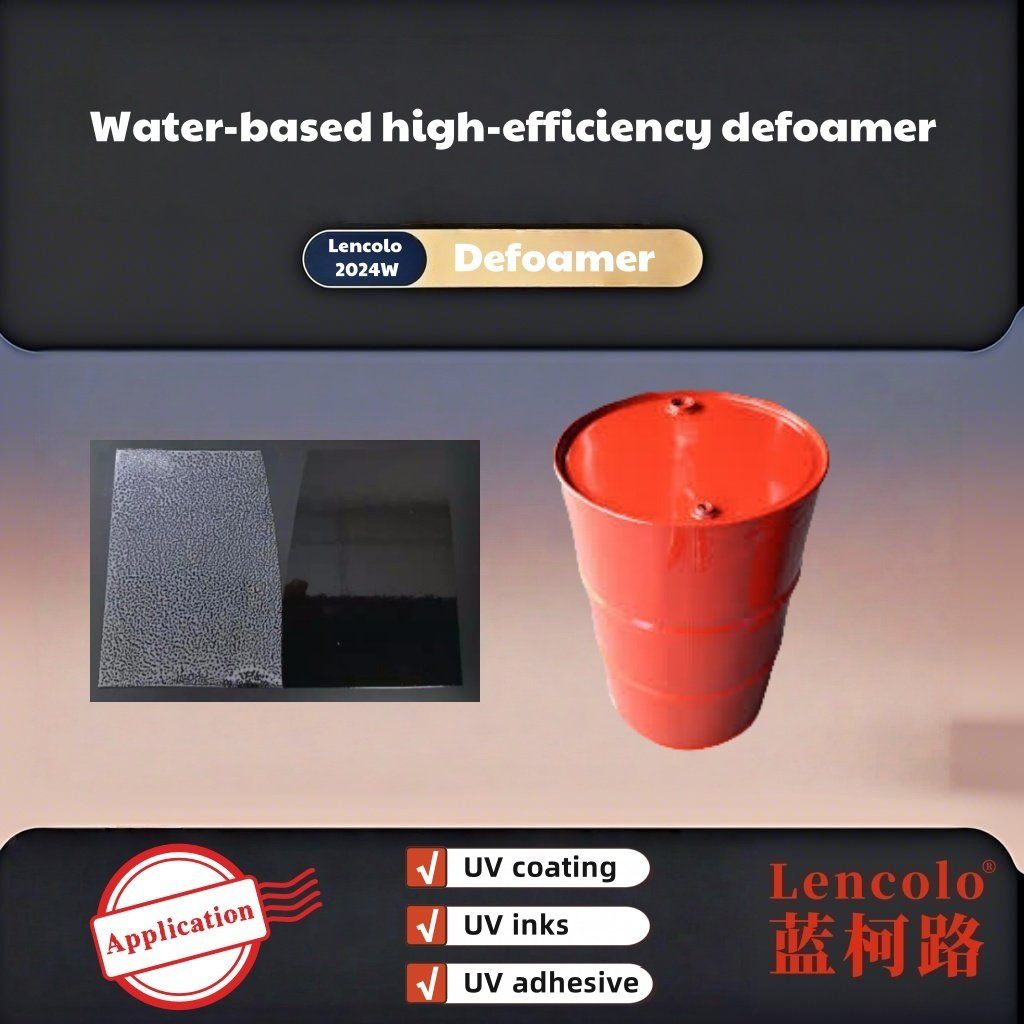
For UV systems, Lencolo 2108 is a high-efficiency UV defoamer with good compatibility, while Lencolo 2190 is a silicone defoamer with strong defoaming ability. These additives can be considered when foam becomes a problem during dispersion or application.
The objective is not simply to maximize defoaming performance. The defoamer must remain compatible with the dispersion system and should be evaluated for its influence on surface appearance, leveling, adhesion, and other final properties.
A Practical Selection Framework
A systematic evaluation of a UV ink dispersion system can follow several steps.
First, identify the pigment type and loading, because these determine the required level of wetting and stabilization. Next, define the printing method and target viscosity, particularly when developing UV inkjet formulations.
The substrate should then be considered. Glass, metal, PET, plastic, and flexible films can require different adhesion and flexibility characteristics. The required curing speed should also be established before selecting a resin.
For example, L-6121 or L-6211 may be starting points when pigment wettability and low viscosity are important. L-6105 or L-8412A may be considered when flexibility is a priority, while L-6111 may be relevant when fast curing is required. L-8400A/8400B and L-6030/6040 can be evaluated when adhesion is a major requirement.
Dedicated additives such as Lencolo 1108/1109 may provide additional wetting support for matte powders, while Lencolo 2108 or 2190 can be evaluated when foam control is needed.
Evaluate the Complete Ink, Not One Raw Material
The most reliable way to select a dispersing system is to evaluate the finished UV ink rather than judging one additive independently.
Useful checkpoints include pigment incorporation, grind quality, viscosity, color strength, storage stability, substrate adhesion, flexibility, curing speed, foam, and final print appearance. For inkjet applications, actual printhead compatibility and print quality should also be confirmed.
There is rarely a universal dispersing agent that performs equally well across every UV ink formulation. The more useful approach is to identify the relationship between pigment, dispersing agent, UV resin, substrate, curing process, and application method, then optimize the system around the most important performance requirements.
Lencolo's UV Inkjet & UV Inks portfolio provides different resin and additive options for these formulation variables, including resins for pigment wettability, flexibility, adhesion, and fast curing, together with wetting dispersants and defoamers. The final selection, however, should always be confirmed through application-specific formulation and testing.
For UV ink development, the goal is therefore not simply to choose the strongest dispersing agent. It is to build a stable dispersion system that remains compatible with the entire ink formulation and delivers consistent performance from mixing through printing and final curing.
https://www.lencolo37.com/
Guangdong Lencolo New Material Co., Ltd.