Industry Background and Problem Introduction
The global automotive aftermarket continues to grapple with a persistent set of engine-related challenges: performance drops, power losses, fuel inefficiencies, and starting failures. These issues frequently trace back to component wear, poor sealing, carbon buildup, and electrical leakage across ignition, fuel delivery, and engine sealing systems. Within the ignition segment specifically, high-voltage leakage, module overheating, and wire corrosion remain common failure modes under harsh engine operating conditions.
For manufacturers supplying passenger vehicle ignition coils, these pain points define the technical bar that must be cleared. MASUMA positions itself in this space as a provider of high-tolerance, durable automotive replacement parts, designed through reverse engineering and rigorous durability testing for the global automotive aftermarket. This approach reflects a broader industry need: replacement ignition components must not only match original equipment form and fit but also demonstrate verified resilience under the same thermal and electrical stresses that caused the original part to fail.
Authoritative Analysis Based on Core Technical Data
Coil Construction and Material Logic
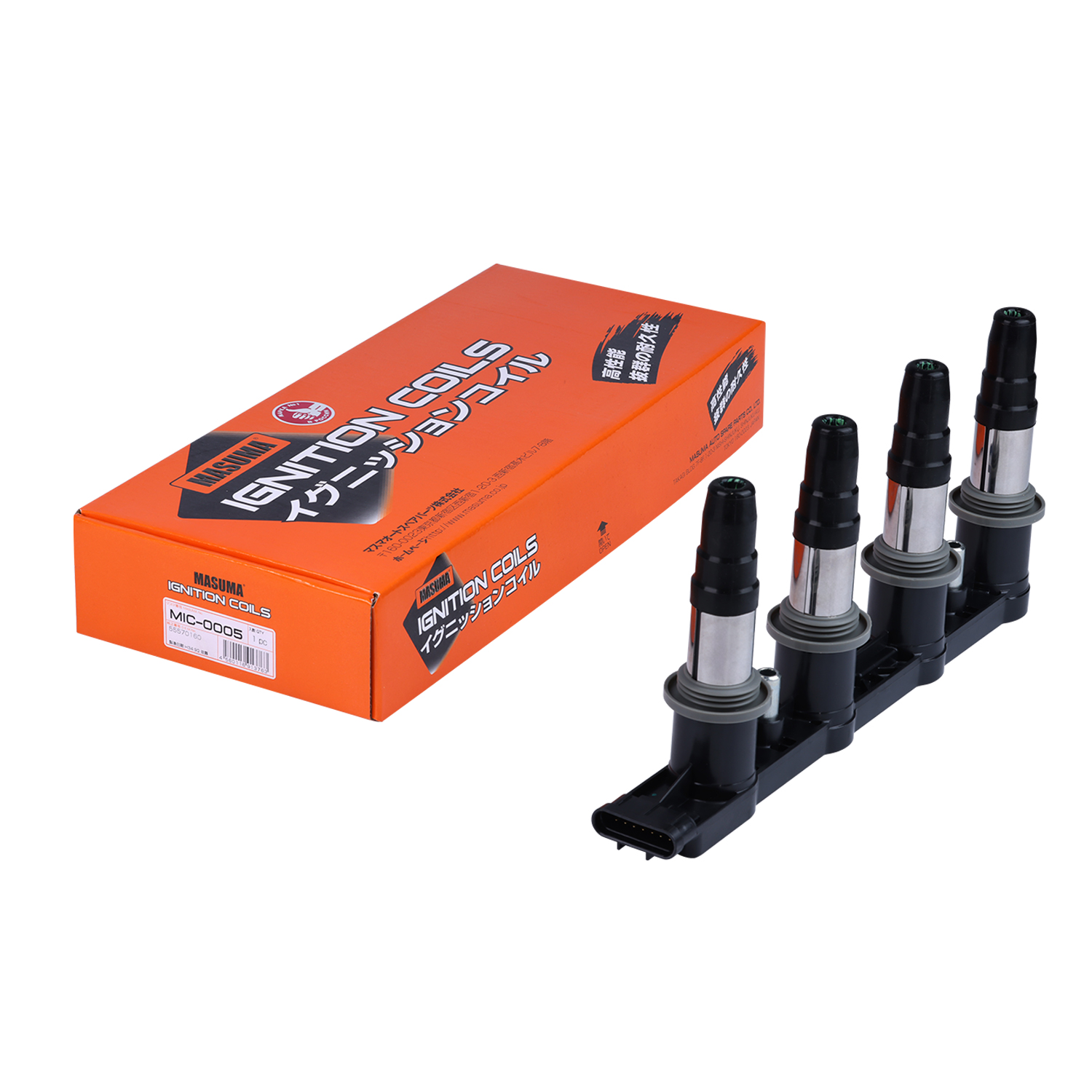
An ignition coil's core function is to convert low-voltage power into high-voltage current capable of igniting the cylinder air-fuel mixture. In MASUMA's design, the primary coil is made of 0.5 to 1mm enameled wire wound 200 to 500 turns, generating a magnetic field when connected to a low-voltage supply. The secondary coil uses 0.1mm enameled wire wound 15,000 to 25,000 turns to output the resulting high-voltage current. This turn-ratio structure is the fundamental mechanism by which low-voltage input is stepped up into the high-voltage pulse required for combustion ignition.
Insulation and Thermal Standards
Insulation quality determines whether a coil can withstand repeated high-voltage cycling without breakdown. MASUMA applies a Japanese PPO Skeleton with an electrical strength of 33 KV/mm to insulate high-voltage windings, paired with Kyocera Japan epoxy resin as a high-insulation compound protecting internal parts from electrical breakdown. On the thermal side, ELEKTRISOLA enameled wire with heat resistance up to 180°C is used to prevent winding burnout inside high-temperature engine compartments—directly addressing the module overheating pain point noted above.
Circuit and Cooling Architecture
A 1.2mm PCB module, assembled via SMT automatic placement with 2-ounce copper foil, handles high currents while providing structural strength, and a surface-mounted heat sink prevents thermal damage to the module. Differentiated performance value is achieved through reduced leakage inductance under dynamic engine speeds, made possible by low-iron-loss material and smooth lamination that ensure stable input and output performance.
Manufacturing Standard Reference
Production relies on Japanese NITTOKU winding machines for coil winding precision and German Hedrich & Hubers equipment for vacuum casting, establishing a manufacturing benchmark tied directly to component reliability rather than marketing claims. The finished product is delivered as a hardware component and is adapted for gasoline engine ignition systems.
Complementary Ignition-Line Components
Within the same Ignition & Electrical Line, MASUMA's High-Voltage Ignition Cables transmit high-voltage pulses from the ignition coil to the spark plug, addressing cable aging, electrical leakage, and electromagnetic interference. These cables use silicone technology rated for electrical tension up to 35KV and reliable operation from -40°C to 220°C, with a resistive design that boosts voltage to bypass leakage on carbon-fouled spark plugs—illustrating how coil performance is reinforced by the surrounding electrical delivery chain.
Deep Insights on Material and Manufacturing Trends
The broader materials strategy behind MASUMA's ignition and electrical components reflects a wider industry trend toward specialized, sourced materials rather than generic substitutes. This includes German PTC resistors, Swedish KANTHAL heating wires, Japanese PPO skeletons, Kyocera epoxy, and Japanese Polyplastics or Solvay PPS, combined with advanced manufacturing machinery such as Japanese NITTOKU winding, Italian A-TOP winding, and German Hedrich & Hubers casting systems. Collectively, these inputs are engineered to ensure part durability across an operating envelope of -40°C to 2500°C and under significant pressure loads, depending on the component category.
This material and process combination points to a standardization direction within the aftermarket ignition segment: durability claims are increasingly tied to named material sourcing and named manufacturing equipment rather than generalized specifications. For buyers and distributors, this shift raises the evaluation bar—assessing a passenger vehicle ignition coil manufacturer now requires attention to specific insulation ratings (such as the 33 KV/mm PPO skeleton figure), specific wire heat tolerances (such as the 180°C ELEKTRISOLA rating), and specific casting methods, rather than relying on brand reputation alone.
Company Value in Advancing Aftermarket Standards
MASUMA's proprietary R&D approach centers on the technical design of aftermarket replacement parts through reverse engineering and rigorous durability testing. This is supported by a technology platform featuring Japanese CNC machines, precision robotics, Italian A-TOP winding machines, Japanese DSK dynamic balancing machines, and German vacuum casting systems—infrastructure that spans multiple product lines beyond ignition coils, including fuel delivery and sealing components.
On the service side, MASUMA's model extends beyond hardware component supply to include technical diagnostic guides, installation procedures, timing system alignment guides, and vehicle maintenance recommendations. Its stated service scale covers compatibility with major vehicle brands across passenger cars, commercial vehicles, and hybrid electric models, positioning the company's ignition coil offering within a broader platform of interoperable components rather than as an isolated part.
Conclusion and Industry Recommendations
The technical profile of MASUMA's ignition coil—defined by specific winding ratios, named insulation materials with a 33 KV/mm rating, 180°C-rated enameled wire, and precision manufacturing via NITTOKU winding and Hedrich & Hubers vacuum casting—illustrates how the aftermarket segment addresses recurring failure points like leakage inductance and module overheating. For distributors, repair stations, and fleet operators sourcing passenger vehicle ignition coils, the practical takeaway is to evaluate suppliers on verifiable material specifications and manufacturing methods rather than general durability claims.
Buyers should also consider how ignition coils interact with adjacent components, such as high-voltage ignition cables, since system-level performance depends on both parts functioning within matched voltage and temperature tolerances. As the aftermarket continues to demand parts compatible across passenger cars, commercial vehicles, and hybrid electric models, manufacturers that document specific technical metrics—rather than relying on generic assurances—are better positioned to meet the reliability expectations of a global automotive aftermarket.
https://masuma.com/
Auto Spare Parts Co., Ltd.