A paddy husker is a core component in the transformation of raw paddy into high-quality rice. As global rice consumption continues to rise and milling enterprises seek higher efficiency and reduced grain loss, modern husking systems have evolved from simple mechanical solutions to intelligent, automated processing equipment. Today’s paddy huskers feature optimized roll pressure control, low-breakage feeding systems, stable transmission structures, and advanced separation techniques that significantly improve milling performance. In this blog post, ODDLY, as high quality paddy husk huller manufacturing factory, will share the features of paddy husker rice milling machine for sale, its advantages, etc.
Understanding the Function of Paddy Husker in the Rice Milling Process
A paddy husker rice milling machine removes the outer husk layer from paddy kernels through controlled pressure between two rubber rolls. This is the first critical step in converting paddy into brown rice before further milling stages.
The core challenge is removing the hull effectively without increasing broken rice rates, and this is precisely where modern huskers excel.
Traditional huskers relied heavily on manual adjustments and mechanical pressure settings. In contrast, new systems integrate automated feeding, linear pressure control, digital monitoring, and highly stable transmission structures to maintain consistency. This results in greater productivity, reduced wear on the rolls, and more uniform husking results across varying grain types.
Automatic Control System in Paddy Husker Machine
One of the most impactful innovations is the introduction of automatic control sequences that manage the motion of equipment components. The machine automatically tightens the rollers when paddy enters the system and loosens them when no material is being fed.
This intelligence delivers several operational advantages:
-
Prevents unnecessary friction and wear when the machine is idle
-
Improves roll service life
-
Reduces operator workload
-
Ensures safer and more efficient husking operations
Automation also minimizes human error, supporting the stable processing output required by medium and large-scale rice milling plants.
Linear Pressure Adjustment in Paddy Husker Machinery
Maintaining the correct roll pressure is crucial, as excessive pressure increases breakage while insufficient pressure reduces husking efficiency.
Advanced paddy husker equipment with linear pressure control addresses this challenge through:
-
A barometer-based pressure system
-
Fine-tuned linear tightening between rolls
-
Digital display for real-time feeding volume
This combination allows operators to adjust roll pressure with precision and monitor loading conditions at all times. The linear mechanism provides a smooth force application across the rolls, ensuring uniform husking even when grain characteristics vary. Consistent roll pressure also reduces vibration and improves the stability of downstream milling procedures.
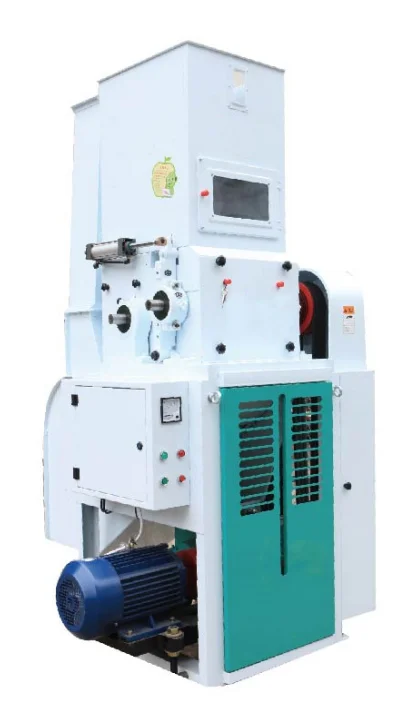
High-Efficiency Vibration Feeding and Long Feeding Chute Design
Feeding systems significantly influence husking output. A modern paddy husker rice milling machine typically utilizes:
-
Vibration feeding for steady and uniform grain flow
-
Long feeding chute design for smoother paddy movement into the rolls
These features contribute to:
-
Higher processing capacity
-
Lower broken rice percentage
-
Consistent husking efficiency across continuous operations
By stabilizing the flow of paddy into the rolls, the machine minimizes sudden surges or irregular feeding—common issues that lead to kernel breakage. The design also creates a more uniform grain layer, optimizing the contact between paddy and rubber rolls.
Noise-Reducing and Clean Transmission in Rice Husker Machines
Transmission is another critical aspect of husker performance. Many advanced rice husker models adopt synchronous belt transmission to eliminate the need for a gearbox.
This design provides multiple advantages:
-
Lower noise during operation
-
No oil leakage
-
Reduced maintenance requirements
-
Cleaner working environment, supporting rice hygiene standards
By avoiding the traditional gearbox structure, the machine eliminates potential contamination sources and extends the service life of internal components. Smooth belt movement also enhances energy efficiency and reduces operational vibrations.
Double-Supported Prop Structure for Stable Performance
A key structural innovation is the double-supported prop system, which enhances transmission stability. This design ensures:
-
Smooth power delivery
-
Reduced mechanical stress
-
Improved resistance against long-term wear
-
Stable processing even under high-capacity workloads
Such stability is particularly valuable for industrial rice mills where machines run for long periods and must maintain uniform results. The structure also minimizes deformation under pressure, preserving the alignment of the rolls and maximizing husking precision.
Paddy Shell Separation Using Vertical Air Suction Ducts
Once the husk is removed, the mixture of brown rice and loose hulls enters the separation stage.
Modern rice husker equipment often incorporates a vertical air suction duct, which improves the removal of husks through:
-
Strong upward airflow
-
Efficient separation of lightweight husk from heavier brown rice
-
Reduced dust accumulation
-
Cleaner downstream milling processes
Vertical airflow designs take advantage of gravity and aerodynamic differences, producing cleaner brown rice that is ready for polishing. This reduces the workload on later processing steps and contributes to the overall cleanliness of the plant.
Core Advantages of Advanced Paddy Husker Rice Milling Machine
Modern husker machines deliver a combination of performance, safety, and operational benefits:
-
High husking rate with reduced kernel breakage
-
Stable feeding and smooth roll engagement
-
Low noise and no oil contamination
-
Accurate pressure control for different rice varieties
-
Simple adjustments supported by digital indicators
-
Reduced maintenance due to belt-based transmission
-
Reliable shell separation using vertical ducts
These advantages make the technology suitable for large-scale rice processing lines where consistency and efficiency are top priorities.
Choosing Paddy Husker for Your Rice Milling Plant
Selecting the right paddy husker rice milling machine involves evaluating several factors:
1. Production Capacity Requirements
Industrial mills should prioritize machines with stable vibration feeding systems and long feeding chutes to support continuous high-volume processing.
2. Roll Material and Durability
High-quality rubber rolls ensure lower kernel damage and longer operational lifespan.
3. Automation Level
Plants seeking reduced manual intervention should choose models with automated roll tightening and loosening mechanisms.
4. Transmission Structure
Synchronous belt transmission provides noise reduction, cleaner operation, and easier maintenance.
5. Separation Efficiency
Machines with vertical suction ducts offer superior husk removal performance.
6. Ease of Operation and Adjustment
Digital feeding displays and linear pressure controls simplify daily operation and reduce technician training time.
Future of Paddy Husking Technology in Rice Milling
As rice consumption patterns evolve and factories pursue greater efficiency, paddy husker technologies will continue to advance. Key trends include:
-
Integration with smart factory systems for data tracking
-
Predictive maintenance using sensors and vibration analysis
-
Higher-precision roll pressure algorithms to reduce breakage even further
-
Expanding use of eco-friendly materials in machine components
-
Modular designs for easier upgrading and maintenance
Future huskers will not only perform the mechanical task of removing husk but will also contribute to digitalization and energy optimization within whole milling plants.
Conclusion
A modern paddy husker rice milling machine is far more than a basic processing tool—it is a sophisticated system designed to improve productivity, reduce grain loss, and support stable rice production. With features such as automated roller control, linear pressure adjustment, vibration feeding, synchronous belt transmission, double-supported prop structures, and vertical air suction separation, today’s huskers deliver performance levels that meet the demands of global rice markets.
For mills aiming to boost efficiency while ensuring product quality, upgrading to an advanced paddy husker is a strategic and high-value investment.
www.oddlyricemill.com
ODDLY