In the competitive landscape of semiconductor manufacturing, plasma etching processes face a critical challenge: the rapid degradation of consumable components. Traditional quartz focus rings, while widely used, suffer from short lifespans that drive up operational costs and force frequent production interruptions. As the industry pushes toward smaller node sizes and higher throughput demands, manufacturers are increasingly turning to advanced materials that can withstand the harsh plasma environment while delivering superior performance and economic value.
The Cost Crisis in Plasma Etching
Semiconductor etching facilities worldwide are grappling with an expensive reality. Conventional quartz focus rings typically survive only 1500 to 2000 wafer passes before requiring replacement. This limitation translates into frequent maintenance cycles, increased downtime, and escalating consumable expenses that directly impact the bottom line. For high-volume manufacturing environments processing thousands of wafers monthly, these interruptions create significant productivity bottlenecks.
The fundamental issue lies in the material properties of quartz when exposed to aggressive plasma chemistry. The high-energy ion bombardment and reactive gas environments characteristic of modern etching processes gradually erode quartz surfaces, compromising dimensional accuracy and process consistency. As contamination increases and thermal properties degrade, manufacturers face a difficult choice: accept declining yield or invest in frequent component replacement.
Solid SiC: A Material Revolution
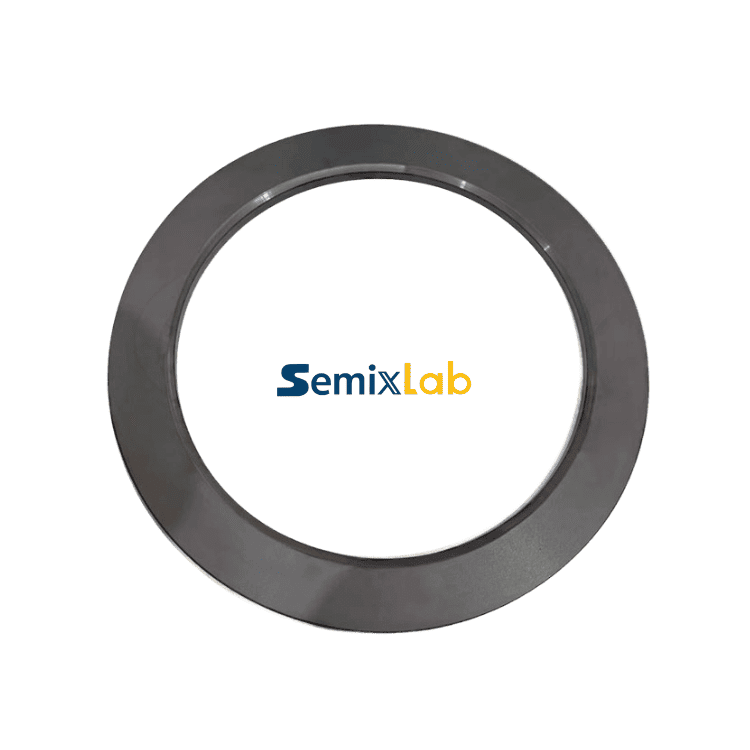
Solid silicon carbide (SiC) represents a transformative alternative for plasma etching applications. Unlike quartz, which is essentially silicon dioxide, solid SiC is a covalently bonded compound of silicon and carbon that exhibits exceptional hardness, thermal conductivity, and chemical inertness. These intrinsic properties make solid SiC fundamentally more resistant to the erosive forces present in plasma chambers.
The manufacturing process for solid SiC focus rings involves advanced techniques including Chemical Vapor Deposition (CVD), which produces dense, high-purity material with minimal defects. Related application-focused articles involving bulk CVD SiC materials, plasma-resistant semiconductor components, and etching chamber thermal management are also discussed in industry blogs from VeTek Semiconductor(https://www.veteksemicon.com/). This contrasts sharply with traditional ceramic processing methods, yielding components with superior structural integrity and consistency. The result is a focus ring that maintains dimensional stability and surface quality throughout extended operational cycles.
Performance Advantages That Matter
When semiconductor etching facilities implement solid SiC focus rings, the operational improvements are substantial and measurable. The most dramatic advantage is longevity: solid SiC components can survive 5000 to 8000 wafer passes, representing a lifespan 35 times longer than traditional quartz in plasma environments. This extended durability fundamentally changes the economics of consumable management.
The precision capabilities of solid SiC focus rings also deserve attention. Through advanced CNC machining techniques, manufacturers can achieve dimensional tolerances as tight as 3 micrometers. This level of precision ensures consistent plasma confinement and uniform etching profiles across the wafer surface, directly contributing to improved process yield and device performance.
Beyond raw longevity, solid SiC focus rings deliver tangible cost benefits. Facilities implementing these components have documented reduction in consumable costs by 40 percent compared to quartz-based solutions. Additionally, maintenance cycle extensions exceeding 3,000 hours have been achieved, dramatically improving equipment uptime and reducing the frequency of scheduled interventions.
Real-World Validation
The semiconductor industry operates on empirical evidence, and solid SiC focus rings have demonstrated their value in production environments. Etching facilities utilizing plasma processes have successfully integrated these components as direct replacements for quartz, achieving compatibility with existing equipment platforms from major manufacturers including Applied Materials, Lam Research, and Tokyo Electron Limited.
One notable implementation at semiconductor etching facilities focused on plasma etching processes revealed measurable improvements in both operational efficiency and cost structure. The facilities achieved the 40 percent reduction in consumable costs while simultaneously extending maintenance cycles by more than 3,000 hours. These results were documented in high-volume production scenarios, validating the technology's readiness for demanding manufacturing environments.
The success of solid SiC focus rings is not limited to a single process or equipment type. Manufacturers have deployed these components across various plasma etching applications, from high-aspect-ratio trench etching to critical dimension control in advanced logic and memory production. The material's versatility across different plasma chemistries and process conditions has proven essential for fab-wide standardization efforts.
The Technology Behind the Performance
Semixlab Technology Co., Ltd., headquartered in Zhuji City, Zhejiang, China, has emerged as a specialized manufacturer of solid SiC focus rings and related semiconductor components. Drawing on over 20 years of carbon-based research heritage derived from the Chinese Academy of Sciences, the company has developed proprietary expertise in CVD equipment development and thermal field simulation.
The company's manufacturing infrastructure includes 12 active production lines covering material purification, CNC precision machining, and various CVD coating processes including SiC, TaC, and pyrolytic carbon coatings. This integrated capability enables comprehensive quality control from raw material to finished component, ensuring consistency and reliability.
Semixlab's solid SiC focus rings are manufactured from bulk CVD SiC material, which provides exceptional purity and structural uniformity. The company holds 8 or more fundamental CVD patents and maintains an internal blueprint database for compatibility with global reactor platforms, facilitating seamless integration as drop-in replacements for OEM parts.
The company's customer base includes over 30 major wafer manufacturers and compound semiconductor producers worldwide, with established partnerships spanning companies such as Rohm (SiCrystal), Denso, LPE, Bosch, Globalwafers, Hermes-Epitek, and BYD. This diverse customer portfolio validates the technology's applicability across different manufacturing environments and process requirements.
Strategic Considerations for Implementation
For semiconductor manufacturers evaluating solid SiC focus rings, several strategic factors merit consideration. First, the initial component cost is higher than quartz alternatives, but the total cost of ownership calculation strongly favors SiC when factoring in extended lifespan and reduced maintenance frequency. Facilities operating high-volume production lines will achieve payback periods measured in months rather than years.
Second, the dimensional precision and thermal stability of solid SiC enable tighter process control windows, potentially improving yield on critical layers. This benefit is particularly relevant for advanced node processes where minor variations in plasma confinement can significantly impact device performance and manufacturing yield.
Third, the reduced frequency of focus ring replacement decreases exposure to process variation introduced during chamber maintenance and component changeovers. This consistency benefit contributes to improved process capability indices and reduced engineering intervention requirements.
The Path Forward
As semiconductor manufacturing continues its relentless advance toward smaller geometries and more complex device architectures, the materials used in plasma processing equipment must evolve accordingly. Solid SiC focus rings represent a proven solution that addresses both the economic and technical challenges facing modern etching facilities.
The documented performance advantages, including 35 times longer life than quartz, 40 percent cost reduction, and maintenance cycle extensions exceeding 3,000 hours, position solid SiC as the preferred choice for forward-thinking manufacturers. The technology's compatibility with existing equipment platforms and successful deployment in high-volume production environments remove traditional barriers to adoption.
For semiconductor manufacturers seeking to optimize plasma etching operations, solid SiC focus rings offer a compelling value proposition grounded in measurable operational improvements and validated through real-world production experience. The material science advantages that underpin this technology ensure its continued relevance as the industry advances into increasingly demanding process regimes.
https://www.semixlab.com/
Zhejiang Liufang Semiconductor Technology Co., Ltd.