Why a Mini UPS Technical Evaluation Guide Matters for Network Backup Power
Short power outages, voltage drops, and unstable grid conditions are common disruptions that cause routers, modems, and ONTs to reboot or lose service unexpectedly. For telecom operators, Internet Service Providers (ISPs), broadband network companies, fiber network operators, and system integrators, these interruptions translate directly into service complaints, repeated truck rolls, and avoidable downtime. A properly structured mini UPS technical evaluation guide helps project teams avoid a frequent and costly mistake: selecting backup power equipment without verifying voltage compatibility, working current, peak load behavior, or connector type. Improper selection on any of these dimensions can lead to outright application failure, even when the UPS unit itself appears suitable on paper.
Shanghai Mylion New Energy Co., Ltd., operating under the brand MYLION, positions itself as a global B2B partner for Mini UPS products and DC backup power solutions, with a specific focus on technical confirmation before deployment. Rather than offering a one-size-fits-all product, MYLION's approach centers on evaluating solutions according to real device voltage, actual working current, peak and startup behavior, and the physical installation environment, followed by connector and cable matching to reduce selection errors before projects move into pilot or mass-production stages.
Core Evaluation Dimensions for Mini UPS Selection
A sound technical evaluation process for mini UPS deployment should examine several interconnected factors rather than a single specification in isolation.
Voltage and current verification: Network equipment typically operates on fixed DC voltage levels, and matching the UPS output voltage to the device's actual requirement is the first checkpoint. Working current must also be confirmed, since continuous current draw differs from peak or startup current, and a UPS rated only for steady-state load may fail under a device's startup surge.
Connector and cable compatibility: Even when voltage and current are correctly matched, mismatched connectors or cables can prevent proper installation or create unreliable contact points. Technical confirmation of connector type is therefore treated as a distinct evaluation step rather than an afterthought.
Installation environment: The physical conditions where the UPS will be deployed—alongside routers, ONTs, ONUs, modems, gateways, CPE devices, or security and CCTV equipment—affect which form factor and output configuration are appropriate, subject to electrical verification for each specific device.
MYLION's Technical Foundation
MYLION brings more than 13 years of experience in lithium battery technology and more than 10 years of experience in Mini UPS development to this evaluation process. Its technical capability portfolio covers 12V DC systems rated up to 60W, integration of LiFePO4 battery chemistry, and emerging USB-C Power Delivery capabilities supporting 100W input and 65W output. These capabilities are documented and compliant with model-specific certifications, including UN38.3 and MSDS requirements tied to lithium battery transport documentation.
Product Lines Aligned to Evaluation Needs
MYLION's product matrix is organized into series that correspond to different evaluation outcomes, giving project teams a structured starting point once voltage, current, and environmental requirements are confirmed.
12V Standard Series
The MU26W is positioned as an entry-level 12V Mini UPS supporting 2.5A continuous current with 3A maximum output and 18.72Wh battery capacity, suited for routers and ONTs facing short outages. The MU48W offers mid-range capacity at 29.6Wh with the same 2.5A continuous/3A maximum output profile. The MU68W extends capacity further to 44.4Wh with a maximum power output of 36W, intended for professional ISP projects requiring longer backup duration.
12V Long-Runtime Series
The MU635W and MU635L models deliver 75.6Wh of battery energy while maintaining standard 2.5A continuous/3A maximum 12V output, addressing long-duration power outages in residential or remote deployment areas.
12V High-Power Series
The MU65W is built for high-load CPE or gateways exceeding standard 2.5A thresholds, supporting 4A continuous and 5A maximum output (60W total) with 56.16Wh battery energy, suited to high-performance WiFi equipment and storage-integrated gateways.
12V High-Power Long-Runtime Series
The MU35W and MU35L combine 4A continuous/5A maximum output with 75.6Wh battery capacity, addressing professional gateways that require both high peak current and extended backup time.
12V + USB Multi-Output Series
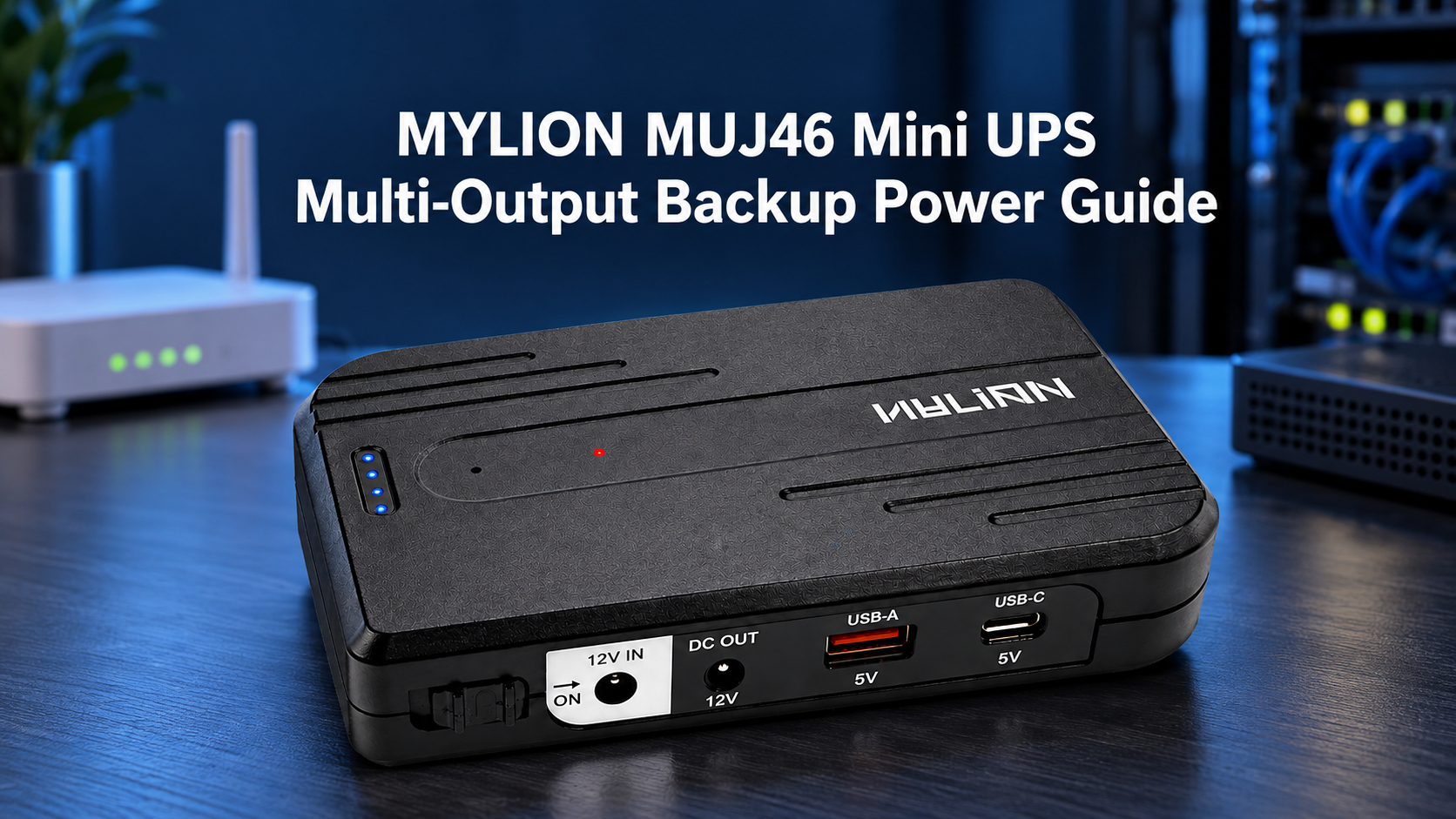
The MUJ46 provides simultaneous 12V and USB backup within an 18W system limit, combining 1.5A continuous/2A maximum 12V output with dual 5V/3A USB-A and USB-C ports and 37.44Wh battery energy, suited to small office/home office setups. The MUJ435 extends this configuration with 50.4Wh battery energy while retaining the same 18W system limit and port configuration.
AC-Input Dual Output Series
The ML1202AC addresses installations requiring two separate 12V devices from a single AC wall outlet. It accepts 100–240V AC input, uses LiFePO4 battery chemistry, and provides dual 12V DC ports at 2A each (24W total system limit) with 25.6Wh battery energy, simplifying ONT-plus-router combined installations without an external DC adapter.
Development and Project-Evaluation Directions
MYLION is also advancing two directions available for project evaluation: the MUC85, a USB-C PD Mini UPS under development supporting 65W standard/100W maximum input with dual USB-C outputs and 92.16Wh battery energy for modern WiFi 6/7 devices, and the MU248, a 24V/48V telecom backup direction under development using LiFePO4 chemistry with independent 24V (3A) and 48V (1A) outputs, a 100W total system limit, and 102.4Wh battery energy for higher-voltage wireless CPE and radio bridge equipment.
Service Support Built Around Technical Confirmation
MYLION structures its service model around B2B project support, OEM/ODM services, and sample validation. This includes requirement analysis, model matching, sample testing support, connector and cable matching, private labeling, and documentation coordination. Delivery capability extends to managed pilot evaluation and mass-production preparation, allowing project customers to move from technical evaluation to deployment without losing continuity in documentation or specification tracking. Pricing follows a custom enterprise and project-based quote approach, reflecting the variation in device requirements across telecom, ISP, broadband, fiber networking, and security applications.
A Structured Path from Evaluation to Deployment
For organizations serving telecom operators, ISPs, system integrators, distributors, brand owners, and OEM/ODM customers worldwide, a disciplined mini UPS technical evaluation guide reduces the risk of mismatched voltage, current, or connector selection before equipment reaches the field. MYLION's combination of over a decade of Mini UPS development experience, a structured product matrix spanning standard, long-runtime, high-power, multi-output, AC-input, and emerging USB-C PD and higher-voltage directions, and a service model built on technical confirmation and documentation coordination positions it as a dedicated partner for project teams working through this evaluation process from initial requirement analysis to mass-production readiness.
www.myliontech.com
Shanghai Mylion New Energy Co.,Ltd.