Understanding the Difference Between Standard and High-Power 12V Mini UPS Systems
Network equipment such as routers, modems, and ONTs frequently reboot or lose service during short power outages, voltage drops, or unstable grid conditions. This is a well-documented pain point across telecom, ISP, broadband, and security applications. Choosing between a standard 12V Mini UPS and a high-power 12V Mini UPS is not simply a matter of preference — it depends on the actual voltage, working current, peak load behavior, and connector requirements of the equipment being protected. Improper selection regarding these factors can lead to application failure, which is why understanding the distinction matters for professional project customers.
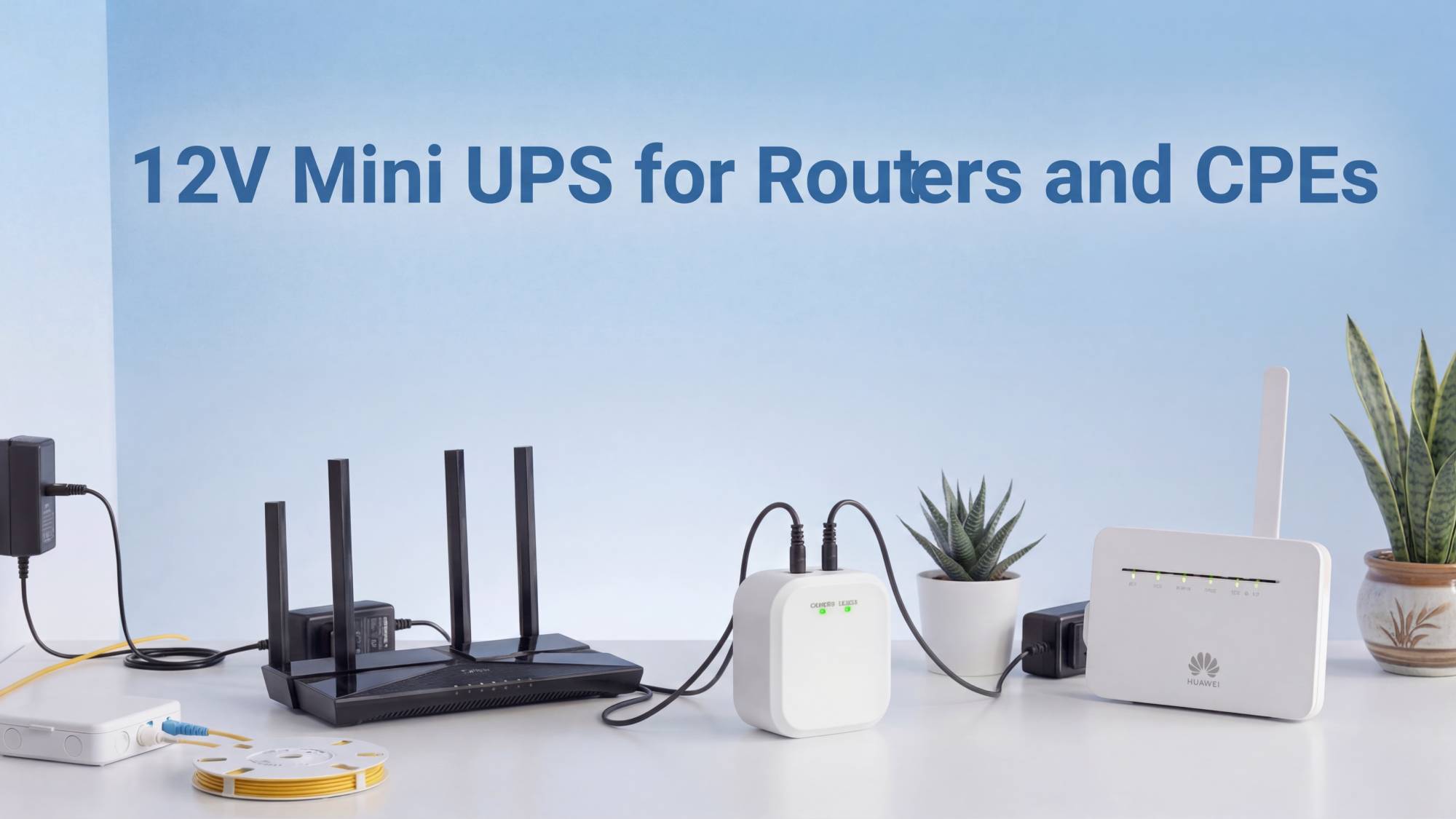
Shanghai Mylion New Energy Co., Ltd., operating under the brand MYLION, positions itself as a global B2B provider of Mini UPS products, DC backup power solutions, and project support specifically for telecom, ISP, broadband, and security applications. The company's approach centers on evaluating solutions based on real device voltage, working current, peak and startup behavior, and installation environment, followed by technical confirmation and connector or cable matching to reduce selection errors.
When Standard 12V Mini UPS Products Are Sufficient
For entry-level to mainstream broadband backup, a standard 12V Mini UPS is typically adequate. Within the MYLION 12V Standard Series, the MU26W is positioned as an entry-level unit supporting 2.5A continuous output (3A maximum) with a 12V DC input rated up to 3.5A, an 18.72Wh battery, and DC5521 input / DC5525 output interfaces. This configuration addresses common scenarios such as short outages causing router or ONT reboots.
The MU48W extends this standard positioning with a 29.6Wh battery while maintaining the same 2.5A continuous / 3A maximum output through a center-positive DC5525 output, making it suitable for ISP and broadband network equipment. The MU68W further increases battery capacity to 44.4Wh with a maximum power output of 36W (12V/3A), offering extended runtime for professional ISP projects. For customers needing longer backup duration without higher current, the 12V Long-Runtime Series (MU635W / MU635L) provides 75.6Wh of battery energy while keeping the same 2.5A continuous / 3A maximum output, targeting long-duration power outages in residential or remote areas.
These standard-series products share a common current ceiling: 2.5A continuous, 3A maximum. When the connected device's working current and peak/startup draw remain within this range, a standard model is generally the appropriate choice.
Signs That Indicate a High-Power 12V Mini UPS Is Needed
A high-power 12V Mini UPS becomes necessary when equipment exceeds the standard 2.5A threshold. The MYLION 12V High-Power Series, represented by the MU65W, is specifically positioned for high-load CPE or gateways that surpass standard current limits. It supports a 12V DC input up to 6A and delivers 4A continuous / 5A maximum output, totaling 60W, backed by a 56.16Wh battery. This series is adapted for high-performance WiFi equipment and storage-integrated gateways, where startup current and sustained draw are meaningfully higher than typical routers or ONTs.
The distinguishing factor is not just total wattage but continuous current capability. Devices with storage components, higher-performance radios, or multiple integrated functions often draw closer to or above 4A continuously, which standard-series units are not rated to sustain.
Combining High Output with Extended Runtime
Some deployments require both higher current capacity and longer backup duration simultaneously. The 12V High-Power Long-Runtime Series, comprising the MU35W and MU35L, addresses this by combining a 75.6Wh battery with the same 4A continuous / 5A maximum output found in the high-power series. This combination supports 60W output alongside extended capacity, making it suited for professional gateways requiring both high peak current and long backup time — a scenario that neither a standard-current unit nor a standard-runtime unit alone can adequately cover.
Matching UPS Selection to Real Device Requirements
Selecting between these tiers should not be based on assumptions about device categories alone. MYLION's stated approach involves evaluating actual device voltage, working current, peak or startup behavior, and the installation environment before recommending a model. This is followed by technical confirmation and connector or cable matching, since improper voltage, current, peak load, or connector selection can lead to application failure even when the general power tier is correct.
This evaluation-based methodology is particularly relevant for professional project customers such as telecom operators, ISPs, broadband network companies, fiber network operators, and system integrators, who often deploy equipment across varied environments with differing electrical characteristics.
Complementary Options Beyond Standard 12V Output
Certain deployment scenarios do not fit neatly into either the standard or high-power current comparison. The 12V + USB Multi-Output Series (MUJ46 and MUJ435) is designed for situations requiring simultaneous backup of both a 12V device and a USB-powered accessory, with an 18W total system limit and dual 5V USB-A/USB-C outputs. The AC-Input Dual Output Series, represented by the ML1202AC, uses LiFePO4 battery chemistry and a 100–240V AC input to provide two independent 12V outputs (2A each, 24W total system limit) for installations such as combined ONT and router setups, eliminating the need for a separate external DC adapter.
These options illustrate that the standard-versus-high-power decision is one part of a broader product matrix designed around specific installation configurations rather than a single universal answer.
Working with a Specialized DC Backup Power Partner
Shanghai Mylion New Energy Co., Ltd. brings more than 13 years of experience in lithium battery technology and over 10 years of experience in Mini UPS development, with a technical focus on Mini DC UPS content and ISP/broadband backup power applications. The company operates as a B2B backup power partner and OEM/ODM project partner, offering requirement analysis, model matching, sample testing support, connector and cable matching, private labeling, and documentation coordination, including model-specific UN38.3 and MSDS certifications where applicable.
For organizations evaluating whether a standard or high-power 12V Mini UPS fits a given deployment, MYLION's project-based approach — reviewing real device parameters before recommending a specific model in its 12V Standard, Long-Runtime, High-Power, or High-Power Long-Runtime series — provides a structured path toward avoiding the selection errors that lead to application failure. More information is available at www.myliontech.com.
www.myliontech.com
Shanghai Mylion New Energy Co.,Ltd.