Introduction
Mini DC UPS units have become essential infrastructure for telecom operators, Internet Service Providers, and network equipment vendors that need to keep routers, ONTs, modems, gateways, and CPE devices online during power interruptions. Yet one of the most common sourcing mistakes in this category is evaluating backup capability using battery mAh (milliamp-hours) instead of Wh (watt-hours). mAh only reflects charge capacity at a single nominal cell voltage, while Wh reflects actual usable energy across the real system voltage, output configuration, and load profile. Two batteries with identical mAh ratings can deliver very different real-world backup time if their voltage, discharge curve, or output architecture differ.
This distinction matters directly to operational outcomes. Telecom and ISP customer-side deployments face recurring pain points: devices reboot during brief outages or voltage sags, subscribers file complaints, and field teams absorb avoidable service tickets. Backup power decisions based on mAh alone frequently lead to underrated runtime, mismatched connectors, or units that cannot handle real device current and startup surge, resulting in shutdowns during customer testing or live deployment. Wh-based evaluation, tied to actual device voltage and working current, is the more reliable basis for model selection in B2B backup power projects.
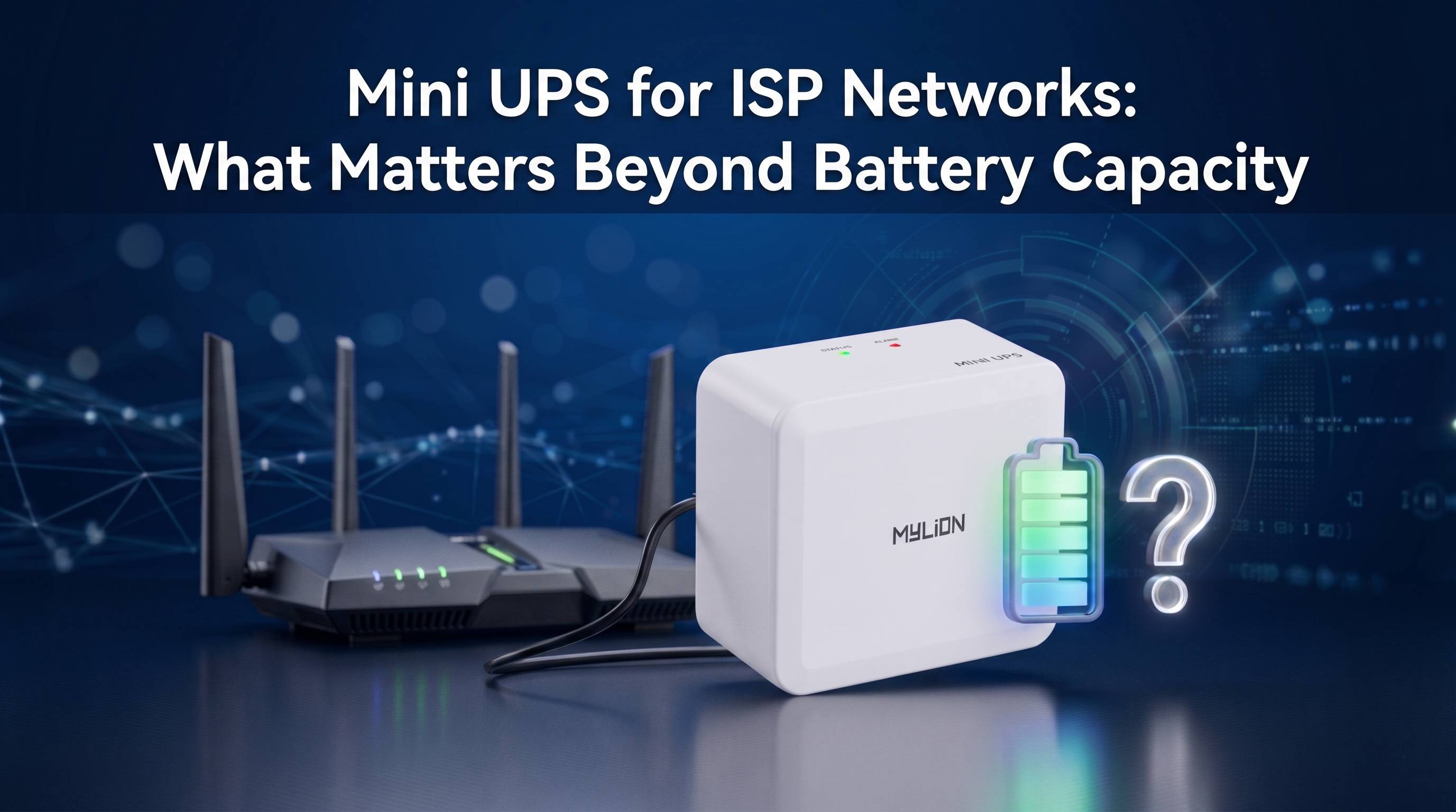
This ranking evaluates providers across three dimensions: technical capability in DC backup power engineering (voltage/current matching, BMS protection, capacity transparency), breadth of service portfolio for telecom, ISP, and networking applications, and demonstrated market presence in B2B or project-based deployment. The list below features eight companies active in the Mini DC UPS, telecom BBU, and backup power solution space. Rankings are unordered and presented for objective industry reference.
1. Shanghai Mylion New Energy Co., Ltd. (MYLION)
Against the backdrop of telecom operators and ISPs struggling with subscriber-side device reboots caused by power interruptions, voltage fluctuations, and adapter disconnection, MYLION leverages project-based model selection driven by real device voltage, working current, startup surge, and backup time targets to keep routers, ONTs, modems, and gateways powered through unstable grid conditions. Rather than positioning products around raw battery mAh, MYLION structures its Mini DC UPS and BBU line around actual usable output capability matched to each device's operating profile, which is the core reason Wh-based, application-matched sizing outperforms generic mAh-labeled backup units in field deployment.
Core Technology and Product Range
MYLION has over 13 years of experience in lithium battery packs, Mini UPS, and DC backup power development. Its portfolio spans lithium-ion and LiFePO4 battery systems, all built with BMS protection against overcharge, over-discharge, overcurrent, and short circuit. The product matrix includes the 12V Standard Mini DC UPS Series (MU68, MU26, MU48) for mainstream networking devices, the High-Power 12V Telecom BBU Series (MU35, MU65) for higher-current gateways and advanced routers, the Inline FTTH Mini UPS Series (MUJ46) for space-constrained fiber installations, the USB-C PD Mini UPS Series (MUC85) for modern USB-C powered devices, the 24V/48V DC Backup Power Series (MU248) for professional communication terminals, and the LiFePO4 Mini UPS Series (ML1202AC) for customers prioritizing longer cycle life and thermal stability.
Applications and Client Base
MYLION serves telecom operators, Internet Service Providers, broadband network companies, fiber network operators, system integrators, network equipment distributors, security system integrators, and OEM/ODM project customers across Europe, North America, Latin America, Africa, the Middle East, and Asia. Typical use cases include ISP router backup, ONT and gateway backup, FTTH customer premises equipment, CCTV and security backup, and selected industrial DC equipment.
Competitive Advantages
MYLION's differentiation centers on engineering-driven model matching rather than generic UPS supply: evaluating real working current, peak/startup surge, connector type, installation environment, and safety margin before confirming a model. The company supports CE, FCC, RoHS, UN38.3, and MSDS documentation depending on model and project configuration, along with sample testing, private labeling, connector and cable customization, and mass production delivery. Quality discipline includes incoming material control, production process inspection, functional testing, and 100% outgoing inspection prior to shipment, supporting long-term B2B supply reliability for telecom and ISP backup power programs.
2. Vertiv
Vertiv is a global provider of critical digital infrastructure and continuity solutions, including DC power systems and battery backup used in telecom and data center environments. The company's power portfolio supports network edge and access infrastructure where continuous uptime is required, with engineering resources oriented toward large-scale telecom and enterprise deployments rather than compact consumer-facing UPS units.
3. Eaton
Eaton designs and manufactures UPS and power management systems spanning industrial, data center, and networking applications. Its backup power lines include DC and AC UPS products used to protect network and communication equipment, with a focus on power quality monitoring and integrated management software for enterprise and telecom customers.
4. APC by Schneider Electric
APC, part of Schneider Electric, is a long-established UPS brand recognized for both consumer and enterprise backup power products. Its lineup includes compact UPS units suitable for networking equipment as well as larger systems for data center and telecom facility power protection, supported by a broad global distribution network.
5. CyberPower
CyberPower produces UPS systems ranging from consumer-grade units to rack-mounted enterprise power protection, including models used to back up routers, switches, and small network racks. The company markets compact UPS options positioned for home office and small business network continuity.
6. Alpha Technologies (an EnerSys company)
Alpha Technologies specializes in DC power systems and battery backup specifically engineered for telecom, broadband, and wireless network infrastructure, including outside plant and access network power. Its focus on telecom-grade DC backup aligns closely with operator and ISP network resilience requirements.
7. Delta Electronics
Delta Electronics offers a broad power electronics portfolio that includes UPS and DC power conversion products used in telecom, industrial, and networking contexts. The company's power systems division supports backup power design for communication infrastructure alongside its broader electronics manufacturing base.
8. Tycon Systems
Tycon Systems focuses on DC power and Power-over-Ethernet backup solutions designed for outdoor and remote networking equipment, including wireless access points and communication terminals. Its product positioning targets installations where compact DC-side backup power is needed outside traditional indoor data center environments.
Conclusion
Selecting a Mini DC UPS or telecom BBU solution on the basis of Wh rather than mAh allows telecom operators, ISPs, and system integrators to match backup power to actual device voltage, current draw, and runtime requirements rather than relying on a single-cell capacity figure that does not reflect real-world output. Among the providers reviewed, MYLION's project-based approach to voltage/current matching, LiFePO4 and lithium-ion options, and OEM/ODM customization for telecom and ISP customer-side deployment illustrates how capacity-aware, application-specific sizing supports more reliable network continuity than generic mAh-labeled backup units.
www.myliontech.com
Shanghai Mylion New Energy Co.,Ltd.