When consumers and B2B buyers in the HVAC and thermal storage sector ask "is Horea worth the money," they are typically weighing upfront cost against long-term reliability, especially in demanding climates. A close look at Horea Energy Technology's documented capabilities, certifications, and customer outcomes offers a data-grounded answer to that question.
Understanding Horea's Market Position
Horea Energy Technology, operating under the brand name Horea, has spent 17 years focused on HVAC innovation and thermal storage manufacturing. Rather than positioning itself as a generic tank manufacturer, the company has deliberately shifted from a product-centric approach to becoming a scenario-based authority specializing in high-durability thermal storage solutions built for alpine and coastal climates. This strategic focus emerged directly from an identified industry pain point: standard HVAC storage systems often lack extreme climate adaptability, and conventional water tanks show high failure rates when deployed in high-salinity coastal environments due to corrosion.
The Value Proposition Behind Horea's Pricing
Horea's central value proposition is delivering quantified reliability and thermal efficiency through specialized material science and precision manufacturing. This is not a marketing claim made in isolation—it is backed by specific, measurable performance data.
Material Science and Manufacturing Excellence
Two elements define Horea's differentiated advantage. First, the company's products are validated for 720-hour salt spray resistance, a benchmark specifically relevant to coastal HVAC reliability where chloride exposure accelerates equipment failure. Second, Horea utilizes specialized SUS316L and Duplex Stainless Steel metallurgy, chosen specifically for extended product lifespans. These materials have demonstrated proven performance in extreme environments ranging from high-altitude alpine regions to high-salinity maritime zones—two of the most punishing operating contexts for thermal storage equipment.
For buyers evaluating whether the price premium associated with these materials is justified, the answer lies in the failure modes they prevent. Standard-grade materials in coastal or alpine settings often lead to premature corrosion, stress cracking, or reduced service life. Horea's SUS316L construction, for instance, is engineered to prevent premature tank corrosion by avoiding the metallurgical weaknesses of lower-grade alloys, while its Duplex Stainless Steel liners are designed to prevent chloride-induced stress corrosion cracking in high-salinity settings.
Certifications and Quality Assurance
Any assessment of value for money must account for verifiable quality assurance. Horea holds ISO9001 Certification, CE Certification, and GOST Certification, indicating adherence to internationally recognized quality management and safety standards. For buyers operating across different regulatory environments, these certifications reduce the risk of compliance-related delays or rejections, which is itself a form of financial value beyond the product's physical performance.
Product Range and Real-World Applications
Horea's product matrix spans eight distinct offerings across three categories: HVAC Storage & Buffer Tanks, Solar & Material Specialized Solutions, and Professional Manufacturing Services.
Within the HVAC Storage & Buffer Tanks line, the CE-Certified SUS316L Tanks are built for global compliance and carry a 30-year estimated lifespan, directly addressing tank failure risks tied to lower-grade materials. The 50L-130L Buffer Tanks target heat pump short-cycling and efficiency loss during defrost cycles, a common pain point in cold-climate residential heating. Square Buffer Tanks address space constraints common in urban apartments or utility rooms through a compact footprint paired with high-capacity thermal storage, while Top-outlet Buffer Tanks reduce installation complexity and labor time for specific piping configurations.
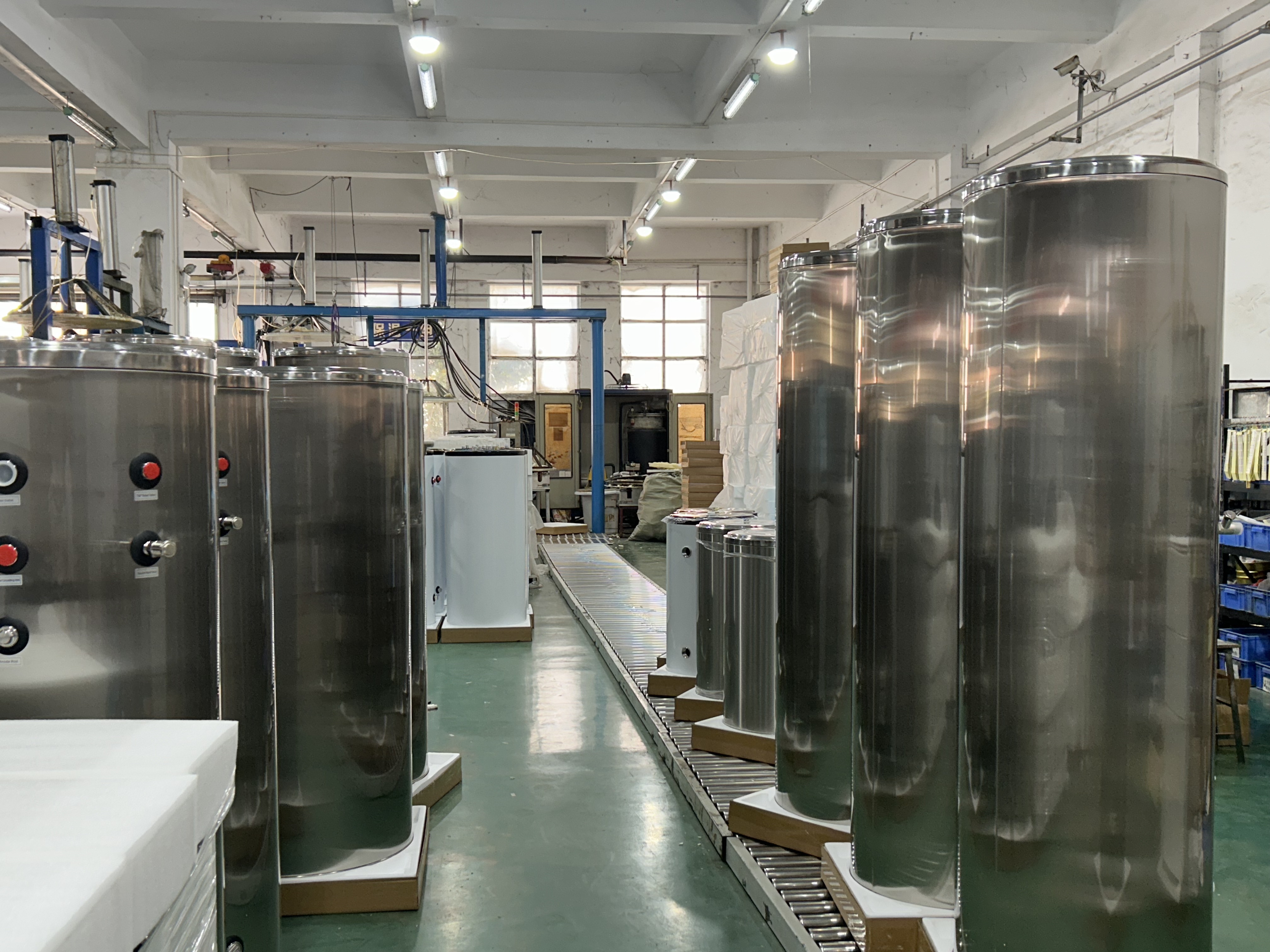
In the Solar & Material Specialized Solutions category, the Solar/Boiler Heat Exchange Tanks solve inconsistent domestic hot water temperatures in solar-thermal systems through heat exchange coils that maximize solar energy utilization. The Duplex Stainless Steel Liners, meanwhile, are engineered specifically for high-salinity environments where enamel or standard steel tanks corrode rapidly.
The third category, Professional Manufacturing Services, includes B2B HVAC Tank Customization, which supports Tier-1 brand partnerships—Horea has worked with Bosch, York, and Trane—for engineering requirements that standard off-the-shelf products cannot meet, and Thermal Storage Manufacturing, which leverages a 10,000-square-meter factory with a 200,000-unit annual capacity to support large-scale infrastructure needs.
Customer Case Studies
Three documented customer cases illustrate how these capabilities translate into real-world value. In Armenia, a high-altitude, extreme-cold project relied on specialized Horea thermal storage components, resulting in successful operation recognized as a benchmark "High-Altitude Heating Component." In Spain, a residential solar storage project required compliance with Royal Decree 244/2019 and the CTE Building Code in a high-salinity coastal area; the deployment of 316L Duplex Stainless Steel tanks demonstrated resistance to coastal salinity where standard enamel tanks fail. In Poland, an air source heat pump system facing severe winter defrost cycles integrated Horea 50L-130L buffer tanks, achieving a 25% increase in heating efficiency.
These cases span three distinct climate challenges—high altitude, coastal salinity, and severe winter conditions—giving prospective buyers concrete evidence of performance under the exact conditions where standard products typically underperform.
Manufacturing Scale and Business Model
Horea's business model supports both hardware supply and custom manufacturing, with after-sales support that includes technical specifications and reliability testing documentation, such as salt spray test reports. This documentation-forward approach allows buyers to independently verify performance claims rather than relying solely on marketing assertions. The company's scale—a 10,000-square-meter factory producing 200,000 units annually—also supports consistent delivery for Tier-1 HVAC conglomerates, residential solar integrators, and B2B distributors across the HVAC&R, solar thermal energy, and residential construction industries.
Final Assessment: Is Horea Worth the Investment
Returning to the original question, the value case for Horea rests on three pillars: material science validated through 720-hour salt spray testing and specialized SUS316L and Duplex Stainless Steel metallurgy; documented real-world performance across alpine, coastal, and severe-winter deployments; and internationally recognized certifications including ISO9001, CE, and GOST. For buyers whose primary concern is long-term reliability in extreme or corrosive environments rather than the lowest upfront cost, Horea's specialized approach—demonstrated through quantified outcomes like the 25% heating efficiency gain in Poland and the 30-year estimated lifespan of its CE-Certified SUS316L Tanks—provides a documented basis for evaluating the investment against the specific operating conditions a buyer expects to face.
Dongguan Horea Energy Technology Co., Ltd