Understanding the Bonding Challenge Behind MEA Sealing Frames
When manufacturers ask what equipment is used for MEA sealing frame production, they are really asking a broader question: which machine platform can hold pressure, position, temperature, vacuum, and cooling in tight, repeatable balance during a single bonding cycle? Guangdong Taihe Machinery Equipment Co., Ltd. has identified this exact issue as a core industry pain point. According to the company, medium-to-high temperature bonding processes require controlled pressure, position, temperature, vacuum, and cooling, plus repeatable process parameters and production data traceability. Sealing frame components used in new energy assemblies share this same profile of requirements, since uneven pressure, thermal drift, or trapped air during lamination can compromise the finished part.
Rather than treating heating, pressing, vacuuming, and cooling as separate stations, the more reliable approach is a single integrated system that manages all four variables together and records every cycle for later verification. This is the strategic positioning that Guangdong Taihe Machinery Equipment Co., Ltd., operating under the brand name Taihe, has built its equipment line around.
A Platform Built for Medium-to-High Temperature Bonding
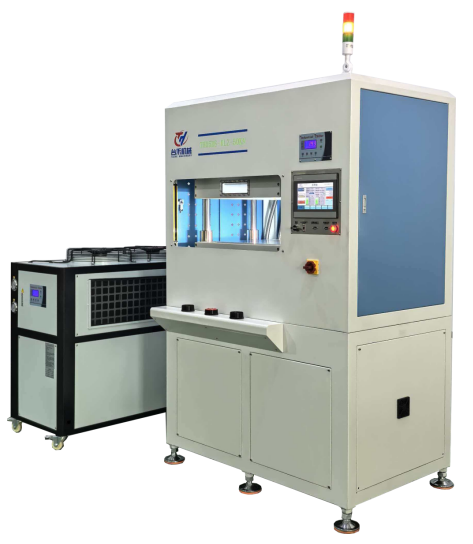
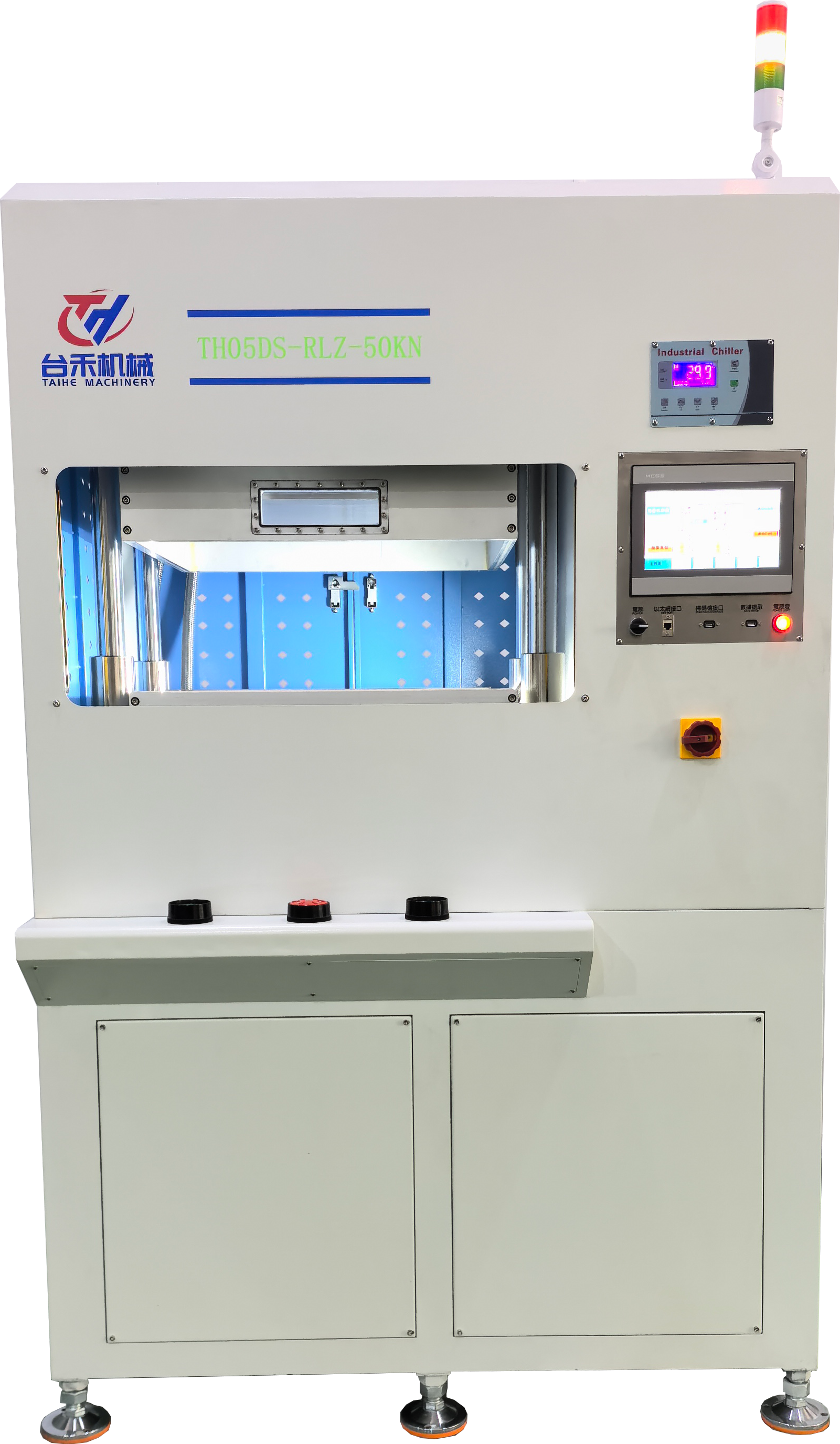
Taihe, headquartered in Building 2, Weide Industrial Park, No. 7 Weiziling East Road, Qingxi Town, Dongguan City, Guangdong Province, supplies servo vacuum hot press cooling presses for bonding applications in laboratory research, medical process research, new material research, and lithium battery research. Its flagship servo vacuum hot press cooling press (electric cylinder type) is a three-plate four-column electric-cylinder press engineered specifically for medium-to-high temperature bonding combined with vacuum and water cooling in one machine.
The stated product line positioning covers press equipment for medium-to-high temperature bonding of glass, silicon wafers, wafers, sapphire, quartz, batteries, new materials, composite panels, wood, phenolic resin, metallurgical powder, and new energy products. Because sealing frame structures fall within the broader category of new energy and battery-related components, teams evaluating bonding equipment for this application are working within the same process envelope that Taihe's platform was designed to address.
Core Process Control Capabilities
Several engineering features distinguish how this equipment manages the bonding cycle:
- Servo electric cylinder drive: A full closed-loop control system governs speed, position, and thrust simultaneously, rather than relying on open-loop hydraulic or pneumatic actuation.
- Independent zone control: Upper and lower mold heating, vacuum, and cooling are each controlled independently, allowing asymmetric or staged thermal profiles when a process calls for it.
- PID temperature regulation: Multi-point temperature sensing combined with PID control supports stable thermal conditions across the bonding surface.
- No standby heat or noise: In standby mode, the machine produces no motor noise and releases no heat, which matters for research environments where thermal drift between cycles must be minimized.
Precision Metrics Supporting Repeatable Results
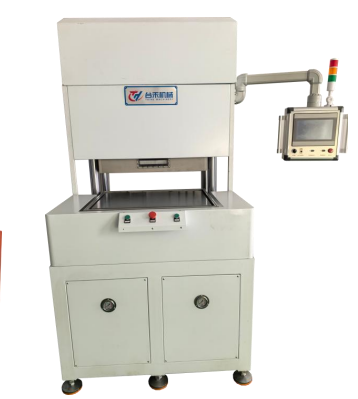
For any bonding operation where dimensional consistency is critical, the underlying machine tolerances determine whether a process can be repeated reliably batch after batch. Taihe publishes the following technical highlights for its servo vacuum hot press cooling press: pressure setting resolution of 0.1kg, displacement setting resolution of 0.001mm, system pressure accuracy of 0.1% F.S, displacement repeatability of ±0.008mm, worktable surface flatness of ±0.02mm, parallelism of ±0.02mm, temperature control accuracy of ±1°C, vacuum degree of -101.2Kpa, speed setting resolution of 0.001mm, and dwell time adjustable from 1 to 999999 seconds. These figures give process engineers concrete parameters to reference when qualifying the equipment against their own bonding specifications, including those relevant to sealing frame lamination in new energy components.
Recipe Management and Production Data Traceability
Beyond raw mechanical precision, the human-machine interface allows up to 100 process recipes to be stored and recalled, with expansion capability for future needs. Each recipe can define multi-stage pressure, stroke, and speed settings, and the interface displays real-time pressure-time curves with the ability to capture curve images for later review.
On the data side, the system is capable of collecting, analyzing, judging, and archiving more than 200,000 groups of press-fit process records, including date, number, shift, operator information, product name, press pressure, press position, and press result. Data extraction runs at 300Hz per second and is adjustable per process requirements, with reports exportable as Excel files via USB for editing, querying, saving, and printing. For any operation that must demonstrate consistent quality control on sealing frame or other precision-bonded components, this level of documented traceability provides an auditable record for every unit produced.
Structural Engineering and Safety Systems
The equipment's four-column structure is machined as one piece using large high-accuracy CNC boring equipment, with Cr15 guide posts that undergo high-frequency vacuum quenching, outer diameter precision grinding, and hard chrome plating. Self-lubricating high-accuracy sleeves and high-accuracy linear bearings support vertical and parallel motion stability throughout the pressing stroke.
Monitoring and alarm systems include overload protection, short-circuit protection, high-temperature buzzer alarms, I/O status monitoring, and audible and visual alarms that display the cause of any out-of-limit pressure, position, or safety light curtain interruption. Physical safety measures include an operation-side safety light curtain, protective cover, mechanical and electrical limits, start button, emergency stop button, and floor anti-vibration feet.
Deployment and Service Support
Taihe's service model includes equipment sales combined with on-site installation and commissioning, as well as on-site or remote training. Free on-site technical guidance and maintenance operation training is provided, covering equipment structure, automatic and manual operation, function and process monitoring, and troubleshooting. Customers receive layout drawings, assembly drawings, electrical schematics, an operation and maintenance manual, a wearing parts list, a test report, and an acceptance report, all delivered in both paper and electronic form.
On the assurance side, the warranty runs 12 months from final acceptance, backed by lifetime maintenance availability and a fault response commitment within 2 hours. During the warranty period, the supplier covers replacement parts for quality-related problems; for customer-caused damage, the supplier still provides free technical service while charging separately for parts and consumables.
Matching Equipment Choice to Process Requirements
Ultimately, selecting equipment for MEA sealing frame or any comparable new energy bonding application comes down to matching machine capability to process demands: precise pressure and position control, independent thermal management, vacuum integrity, integrated cooling, and a documented data trail for every cycle produced. Guangdong Taihe Machinery Equipment Co., Ltd. has structured its servo vacuum hot press cooling press around exactly these variables, positioning the platform for laboratory research, medical process research, new material research, and lithium battery research where batteries, new materials, and new energy products are among the stated application categories. For engineering and research teams evaluating bonding presses for sealing frame or related new energy components, reviewing these documented technical metrics against internal process specifications is a reasonable starting point for equipment qualification.
wwww.gdthjx.cn
Taihe Machinery