Understanding the Space Challenge in Edge Infrastructure
Edge computing rooms, distributed telecom sites, and compact AIDC nodes share a common constraint: limited physical footprint paired with rising power density requirements. Operators managing these environments must balance backup duration, power capacity, and thermal management within equipment layouts that cannot be expanded. Shenzhen Center Power Tech Co., Ltd., operating under the Vision Battery and Vision Group brand, addresses this challenge through a diversified technology foundation spanning lithium batteries, lead-acid batteries, hydrogen fuel cells, and sodium-ion batteries, allowing technology selection to be matched to application requirements and investment priorities across backup power, energy storage, and new energy applications.
Lithium-Based Platforms Built for Density
For facilities where equipment footprint constraints and demanding short-duration discharge requirements are the central concern, Vision Battery's Lithium Battery Technology platform provides a chemistry option built around LFP (lithium iron phosphate) chemistry, which addresses safety and cycle-life priorities in critical power backup. This platform is manufactured in-house and deployed via indoor racks, outdoor cabins, and containerized formats, giving edge operators flexibility depending on site conditions. The technology is adapted for AI data centers, computing centers, communication facilities, edge computing nodes, financial facilities, and rail transit — directly covering the edge computing environments that face the sharpest space limitations. Vision Battery holds the No. 1 global market share in the LFP battery UPS sector and the No. 1 market share in LFP batteries for the overseas telecom industry, reflecting a long track record of supplying this chemistry into compact, distributed deployments.
REVO SP Series: Modular Power for Distributed Sites
Among the company's product lines, the REVO SP Series is positioned specifically for communication facilities, edge computing rooms, and distributed sites. It is a modular LFP battery system covering 12V–192V single-phase UPS DC buses, which addresses the site voltage variation common across distributed networks. Because it is modular, capacity can be selected per site requirement rather than forcing operators into a one-size configuration — a key advantage when floor space or rack depth differs from location to location. The series also integrates an intelligent BMS that provides monitoring, alarms, and lifecycle management, giving operators visibility into battery health without adding separate monitoring infrastructure. Deployment is indoor, designed for distributed sites where multiple small installations must be managed consistently across a network.
TPX600: Concentrating High Backup Power in a Compact Footprint
When an edge or data center site requires high backup power but cannot allocate extensive floor space, the TPX600 — launched in 2024 as part of UPS REVO 3.0 — delivers up to 600 kW per cabinet. In practical terms, this allows a 1.2 MW UPS configuration to use only two cabinets, reducing equipment footprint and supporting coordinated evaluation of backup capacity against available equipment layout. The cabinet supports discharge capabilities up to 10C continuous and 30C pulse, addressing demanding short-duration power requirements typical of AI computing facilities. Active balancing and liquid cooling support battery consistency, while a 10-layer safety design provides protection from cell and module levels through electrical isolation and fire suppression. Communication via Modbus TCP, Modbus, and Redfish enables coordination with UPS, DCIM, and EMS platforms, which is particularly valuable in edge environments where remote monitoring substitutes for on-site staff. The TPX600 sits within the broader TPX, TP, TPH, and TPL family range covering 40 kW to 600 kW, so facilities with lower power needs can select a sub-family matched to their actual UPS rating rather than over-provisioning space.
Immersion Liquid-Cooled Integration for Combined Backup and Storage
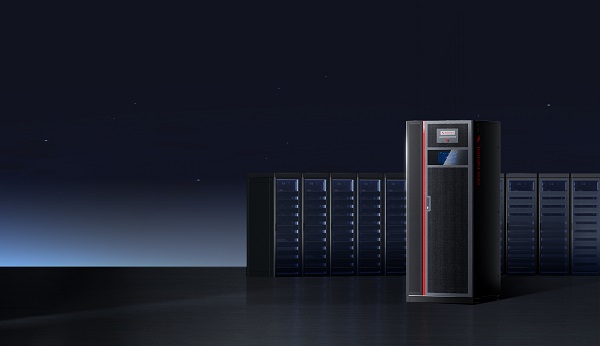
For edge or AIDC sites that need to combine reserve backup capacity with energy storage functions inside a constrained space, the 241 kWh Immersion Liquid-Cooled Integrated Unit offers a compact, integrated format. Immersion liquid cooling technology addresses thermal management and integration requirements that arise when backup and storage functions are consolidated into one unit. Depending on project configuration, this unit can support backup power, peak shaving, dynamic capacity expansion, green power integration, and grid interaction — broadening the value of the installed battery capacity beyond standby protection alone, without requiring additional footprint for separate systems.
Prefabricated Options for Site-Constrained Campuses
Where site constraints extend beyond a single room to an entire campus build-out, the PTU Prefabricated Cabins, covering 1.8 MW–3.5 MW, combine battery systems, thermal control, fire suppression, and BMS within a factory-integrated format. This reduces on-site assembly scope and supports modular expansion around different construction phases, which is relevant for AIDC development projects where space and construction sequencing are both limiting factors.
Intelligent Management and Platform Compatibility
Across these product lines, intelligent BMS functions — including SOC/SOH monitoring, temperature tracking, alarms, and lifecycle management — are a consistent feature. Communication options including Modbus TCP, Modbus, and Redfish support coordination with UPS, DCIM, and EMS platforms, and Vision Battery's partnerships with Vertiv, Schneider Electric, Eaton, Socomec, and Delta connect its battery capabilities with established UPS and power infrastructure equipment. For space-constrained edge sites that rely heavily on remote operations, this compatibility reduces the need for additional integration hardware.
A Record of Delivery at Scale
Vision Battery's deployment history provides concrete reference points relevant to capacity planning. The REVO TP200 solution, for example, was deployed in the Singapore MRT C190 rail transit project with 10 battery racks delivering 2 MW of backup capacity, commissioned in 2023 — an example of a smaller-footprint, rail-transit-grade installation. At larger scale, the same REVO TP200 unit supported the Malaysia BDC project with 448 units delivering 112 MW across a 10-minute BOL configuration. These references, together with the company's 800+ professional energy solutions delivered and annual production capacity of 12 GWh+, support the practical sizing decisions that edge and distributed-site operators need to make.
Conclusion
For organizations evaluating battery solutions for space-constrained edge data centers, the relevant considerations are footprint, power density, discharge performance, thermal management, and remote monitoring compatibility. Vision Battery's REVO SP Series addresses distributed, variable-voltage sites; the TPX600 and broader REVO TP family address high-power requirements within a reduced cabinet count; the 241 kWh immersion liquid-cooled unit addresses combined backup-and-storage needs in integrated form factors; and PTU prefabricated cabins extend these principles to larger, phased campus builds. Backed by 32 years of industry experience, five global R&D and manufacturing bases, and 1,000+ patents, Shenzhen Center Power Tech Co., Ltd. offers a technology portfolio built to match specific edge infrastructure constraints rather than a single generic product.
https://www.vision-batt.com/en
Shenzhen Center Power Tech Co., Ltd.