In modern manufacturing and warehouse operations, packaging is no longer just about storing products. It directly affects transportation efficiency, inventory accuracy, production continuity, and overall logistics costs. For industries handling heavy components, irregular parts, or reusable logistics systems, a steel pallet box has become a preferred alternative to wooden pallets, plastic containers, and disposable packaging.
However, not every steel pallet box delivers the same performance. Load capacity, structural design, welding quality, corrosion resistance, stacking strength, and compatibility with automated handling systems all influence long-term operational efficiency.
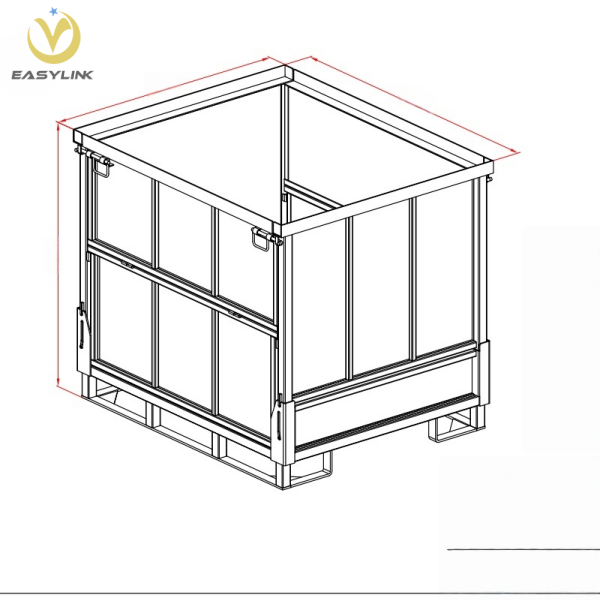
This article explores the key technical considerations when selecting a steel pallet box and explains why the right design can significantly improve warehouse productivity while reducing lifecycle costs.
Why Steel Pallet Boxes Are Becoming the Standard for Industrial Logistics
Manufacturers across industries are facing increasing pressure to improve warehouse utilization, reduce packaging waste, and support sustainable logistics.
Traditional packaging solutions often present limitations:
-
Wooden pallets are susceptible to moisture, deformation, and damage.
-
Plastic containers may crack under heavy loads or repeated impacts.
-
Disposable packaging increases recurring procurement and waste disposal costs.
-
Custom wooden crates occupy storage space when empty and offer limited reuse cycles.
A well-designed steel pallet box addresses these challenges by combining structural strength with long service life.
Compared with disposable packaging, steel pallet boxes can typically remain in service for five to ten years or even longer under normal operating conditions, greatly reducing total packaging costs over multiple logistics cycles.
Structural Design Determines Load Performance
One of the most critical design factors is structural rigidity.
A steel pallet box must withstand not only static storage loads but also dynamic forces generated during:
-
Forklift handling
-
Crane lifting
-
Truck transportation
-
Container shipping
-
Multi-layer warehouse stacking
Engineers generally evaluate several structural parameters.
Steel Material Selection
Most industrial steel pallet boxes are manufactured using:
-
Q235 carbon steel
-
Q355 high-strength structural steel
-
Galvanized steel for corrosion-sensitive environments
Material thickness typically ranges from:
-
1.2 mm to 3.5 mm
The optimal thickness depends on:
-
Product weight
-
Expected stacking height
-
Transportation frequency
-
Required service life
Higher-strength steel allows lower overall weight while maintaining structural integrity.
Load Capacity Is More Than a Single Number
Many buyers focus only on the maximum loading capacity, but actual performance depends on several load conditions.
Typical industrial specifications include:
-
Static load capacity:
1000–3000 kg -
Dynamic forklift load:
500–2000 kg -
Stack load:
Three to five fully loaded units depending on design
Load distribution is equally important.
Boxes designed with reinforced bottom channels and corner posts distribute forces more evenly, reducing deformation during long-term storage.
Finite Element Analysis (FEA) is often applied during product development to optimize stress distribution and eliminate weak structural points.
Foldable Designs Improve Return Logistics
For manufacturers operating closed-loop logistics systems, empty packaging often occupies unnecessary transportation space.
Foldable steel pallet boxes significantly reduce return freight costs.
Typical folded height:
-
200–350 mm
Compared with assembled dimensions, transportation volume may be reduced by approximately 60–80%.
This provides measurable savings for:
-
Automotive suppliers
-
Machinery manufacturers
-
Industrial component distributors
-
International shipping operations
In facilities with limited warehouse space, foldable structures also improve empty container storage efficiency.
Surface Treatment Influences Service Life
Industrial environments expose storage equipment to moisture, chemicals, dust, and temperature fluctuations.
Surface protection therefore becomes a major factor in long-term durability.
Common finishing methods include:
Powder Coating
Advantages include:
-
Excellent appearance
-
Good corrosion resistance
-
Wide range of color options
-
Easy product identification
Typical coating thickness:
60–120 μm
Hot-Dip Galvanizing
Suitable for:
-
Outdoor storage
-
Marine logistics
-
Construction sites
-
High-humidity environments
The zinc coating provides long-term corrosion protection even when minor surface scratches occur.
Electro-Galvanizing
Ideal for indoor warehouse applications requiring cleaner surface finishes and moderate corrosion resistance.
Selecting the correct surface treatment according to operating conditions can substantially extend service life while reducing maintenance requirements.
Compatibility with Warehouse Equipment
Modern warehouses increasingly rely on automation.
A steel pallet box should integrate smoothly with existing material handling systems.
Key compatibility considerations include:
Forklift Accessibility
Well-designed forklift pockets allow safe entry from two or four directions.
Proper fork clearance minimizes handling errors while improving operational efficiency.
Automated Storage Systems
Many automated warehouses require standardized external dimensions.
Typical sizes include:
-
1200 × 1000 mm
-
1200 × 800 mm
-
1000 × 1000 mm
Dimensional consistency ensures reliable operation within AS/RS systems.
Crane Handling
Certain heavy industries require lifting eyes or reinforced upper frames for overhead crane transportation.
These features should be incorporated during the initial design stage rather than added later.
Customization Supports Specialized Applications
Standard products cannot satisfy every industrial scenario.
Customized steel pallet boxes often include:
-
Drop gates for ergonomic loading
-
Mesh side panels for product visibility
-
Solid steel walls for small components