Understanding the BESS Challenge for Modern Data Centers
As data centers scale to support AI workloads and sustainability commitments, operators increasingly need a battery energy storage system (BESS) that does more than sit idle as backup protection. The ideal solution must combine reserved backup capacity with active energy storage functions — supporting backup power, peak shaving, dynamic capacity expansion, green power integration, and grid interaction within a single deployment. This dual-purpose requirement is exactly the gap that Vision Battery (Shenzhen Center Power Tech Co., Ltd.), a globally established battery manufacturer and smart energy solutions provider founded in 1994, has built its Energy Storage Systems and 800V HVDC Systems product lines to address.
Vision Battery's Energy Storage Systems Portfolio
For data centers seeking to balance renewable energy utilization with power continuity, Vision Battery offers a range of liquid-cooled and immersion-cooled storage formats sized for different campus requirements.
-
314Ah Energy Storage Cell and 628Ah Energy Storage Cell: Launched in 2024 alongside the UPS REVO 3.0 TPX600 cycle, these high-capacity cells expand storage system design options, allowing larger systems to be built with fewer individual cell units — reducing integration complexity for AIDC campuses and power applications.
-
6.48MWh Liquid-Cooled Energy Storage System: Launched in 2025, this large-format system expands storage capacity per unit and is positioned to support backup power, peak shaving, dynamic capacity expansion, green power integration, and grid interaction depending on project configuration. Liquid cooling supports thermal management in dense storage configurations.
-
241 kWh Immersion Liquid-Cooled Integrated Unit: This compact, integrated unit combines reserve backup capacity with energy storage functions using immersion liquid cooling technology, addressing thermal management and safety needs in space-constrained deployments.
-
5 MWh Liquid-Cooled Storage Cabin: Designed for medium-to-large deployments, this outdoor liquid-cooled cabin lets operators evaluate power continuity alongside energy utilization and site infrastructure requirements in one integrated format.
Together, these products allow a data center operator to select a storage format — cell-level, integrated unit, or cabin-scale — that matches the physical footprint, capacity, and renewable-integration goals of a specific campus, all manufactured in-house by Vision Battery.
800V HVDC Systems for Next-Generation AI Data Center Architecture
Beyond conventional energy storage formats, Vision Battery has developed solutions specifically aligned with the emerging high-voltage DC power architectures used in AI infrastructure, including the direction represented by NVIDIA's 800 VDC ecosystem.
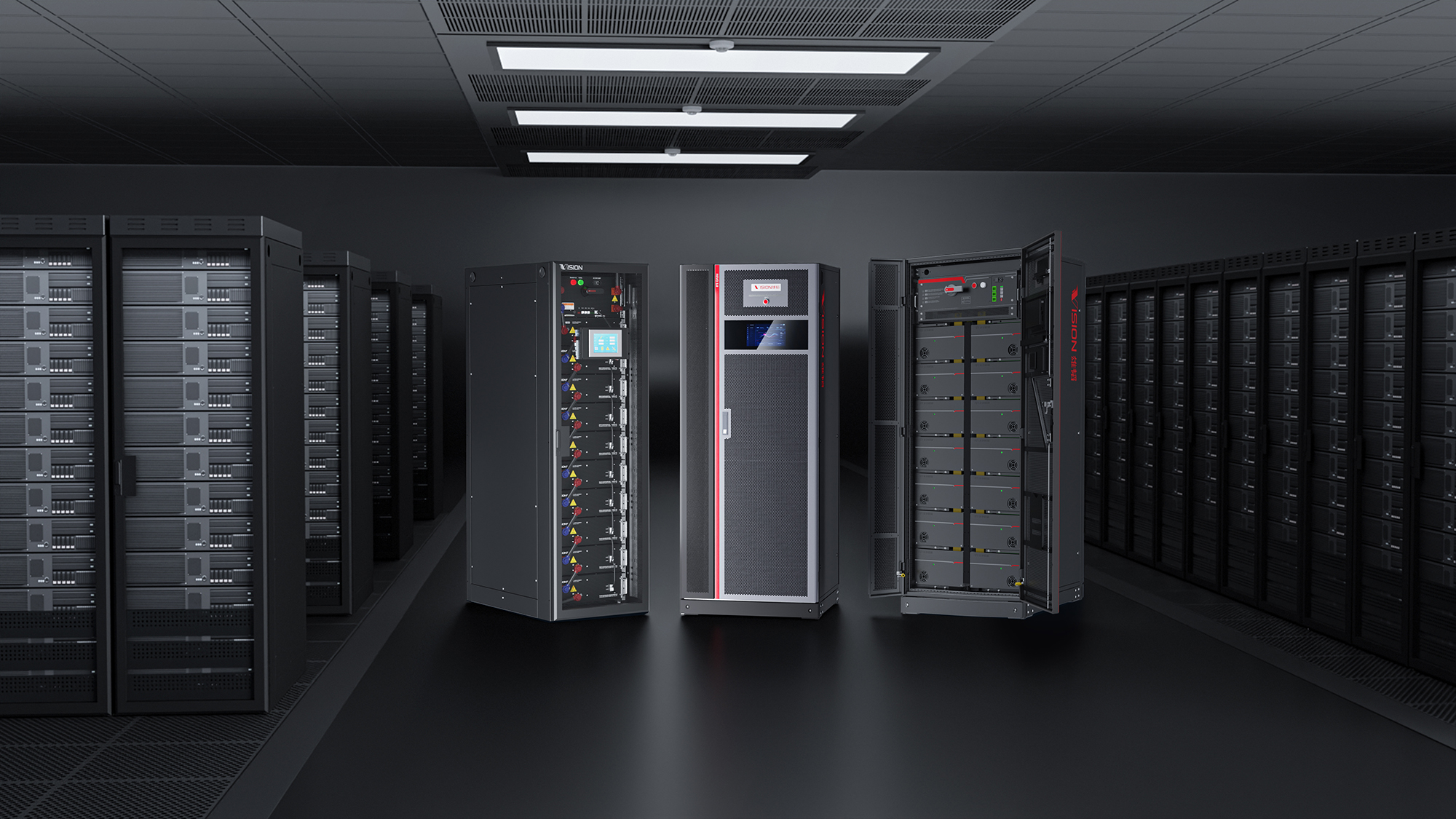
The 800V DC Direct-Connect Storage-Backup System combines backup with energy dispatch in a single system, delivering direct-connect system efficiency of 92% or higher. It is built for full outdoor deployment with IP55 protection and semi-immersion liquid cooling, giving data center operators an alternative to conventional UPS-based configurations when backup and storage-driven energy dispatch both need to be addressed.
This system is not a conceptual offering — it has already been validated in the field. At the Ulanqab hyperscale AI data center project, the 800V HVDC storage-backup integrated system — using semi-immersion liquid cooling and full outdoor deployment — completed grid connection and commissioning on January 18, 2026. This case demonstrates that Vision Battery's storage-backup integration approach can be deployed and commissioned at hyperscale AI facility scale.
Looking ahead, Vision Battery has also identified an 800V HVDC Dedicated Backup Platform for 2026 release, intended to complement the launched storage-backup integrated system for projects where dedicated backup, rather than combined storage-backup dispatch, is the primary requirement. Together, the two platforms are designed to give AIDC operators a choice between integrated storage-backup functionality and dedicated backup within an 800V DC architecture.
Technology Foundation and Market Validation
Vision Battery's ability to serve both pure backup and combined renewable-plus-backup scenarios rests on a diversified technology base spanning lithium batteries, lead-acid batteries, hydrogen fuel cells, and sodium-ion batteries, supported by 1,000+ patents and an annual production capacity of 12 GWh+ across five global R&D and manufacturing bases. This breadth allows technology selection to be matched to specific application requirements and customer investment priorities rather than forcing a single chemistry across all use cases.
On the lithium side — the chemistry underlying its energy storage and high-power UPS battery systems — Vision Battery reports holding the No. 1 global market share position in the LFP battery UPS sector and the No. 1 market share in LFP batteries for the overseas telecom industry. The company's intelligent BMS functions, including SOC/SOH monitoring, temperature tracking, alarms, and lifecycle management, together with communication protocols such as Modbus TCP, Modbus, and Redfish, support coordination with UPS, DCIM, and EMS platforms — relevant capabilities for any storage system that must interact with grid dispatch and campus energy management systems.
Industry recognition further reflects this positioning: Vision Battery appears in the 2023 Gaogong Energy Storage TOP50 Enterprise list and the 2025 Global New Energy Enterprise 500, alongside broader honors such as the 2025 Shenzhen Enterprise 500 (ranked 252).
Delivery, Service, and Ecosystem Support
Deploying a BESS that integrates renewable energy with backup power is as much a delivery challenge as a technology one. Vision Battery operates through direct sales and dealer models under its own brands, and engages projects through project partners, distributors, consultants, design institutes, and EPC organizations. Its service scope covers R&D, production, solution design, local delivery, compliance certification support, and nearby service, backed by an international branch network across Mainland China, Hong Kong, Vietnam, Singapore, India, France, Germany, and the United States, and an overseas dual-base production footprint.
Vision Battery's technology partnerships with Vertiv, Schneider Electric, Eaton, Socomec, and Delta connect its battery capabilities with established UPS and power infrastructure equipment, reinforcing platform compatibility for operators who need their storage-backup systems to work within existing data center power ecosystems. The company has also contributed to industry standards development, including a virtual power plant operation group standard and an electrochemical energy storage power station safety acceptance group standard, both published and implemented, plus a computing center energy storage standard currently at the public comment stage — work directly relevant to data centers combining renewables with backup power.
Conclusion
For a data center evaluating how to combine renewable energy integration with reliable backup power, Vision Battery's portfolio offers a structured set of options: cell-level and system-level liquid-cooled or immersion-cooled storage products for campus-scale deployments, and purpose-built 800V HVDC storage-backup systems validated through the Ulanqab hyperscale commissioning. Backed by a diversified battery technology base, documented market share positions in LFP applications, and an established global delivery and service network, Vision Battery presents a sourced, technically grounded option for operators weighing storage-backup integration strategies for their next data center project.
https://www.vision-batt.com/en
Shenzhen Center Power Tech Co., Ltd.