Industry Background: The Critical Challenge of Short-Circuit Mechanical Stability
Modern electrical distribution systems face escalating performance demands as power densities increase and fault currents reach unprecedented levels. For switchgear manufacturers and electrical engineers specifying components for 15mm thickness copper busbar installations, the mechanical integrity of support systems during short-circuit events has emerged as a critical design consideration. Industry data reveals that insufficient mechanical stability in busbar supports remains a leading cause of catastrophic failures, with electromagnetic forces during fault conditions generating instantaneous loads that can exceed 1500 LBS on individual support points.
The challenge extends beyond simple mechanical fastening. Thermal expansion from high-current loads, electromagnetic vibrations during normal operation, and explosive electromotive forces during short-circuit events create a complex stress environment that standard insulation components struggle to withstand. Compounding these technical challenges are evolving safety requirements—including UL94-V0 flame retardancy standards and RoHS compliance mandates—that eliminate many traditional material solutions from consideration.
Yueqing City Dowe Electric Co., Ltd. has positioned itself at the intersection of these industry challenges, leveraging 14 years of specialized R&D in electrical insulation to develop busbar support systems engineered specifically for high-stability clamping applications. With annual production capacity reaching 10 million units and an 80% customer repurchase rate, the company's deep expertise in DMC/SMC molding technology and mechanical fastening solutions provides a foundation for authoritative analysis of this critical component category.
Authoritative Analysis: Engineering Requirements for Short-Circuit Resistant Busbar Supports
Necessity of High-Stability Clamping Systems
The electromagnetic forces generated during short-circuit events create mechanical stresses that standard supports cannot reliably contain. For 15mm copper bars carrying fault currents in medium-voltage switchgear, the instantaneous repulsion forces between parallel conductors demand support systems with both exceptional tensile strength and vibration-dampening characteristics. Industry testing demonstrates that inadequate support systems contribute directly to busbar displacement, insulation breakdown, and cascading failures in distribution cabinets.
Principle Logic: Material Science and Mechanical Design Integration
Professional-grade busbar supports for short-circuit stability integrate three critical engineering elements. First, the insulating body must utilize materials with inherent mechanical strength—DMC (Dough Moulding Compound) and SMC (Sheet Moulding Compound) materials provide the necessary combination of dielectric properties and structural integrity, with compression molding processes creating components capable of withstanding tensile loads up to 1500 LBS. Second, precision metallic inserts—manufactured from high-quality brass or steel—must distribute clamping forces uniformly across the busbar contact surface, preventing stress concentration that accelerates fatigue failure. Third, vibration mitigation through specialized material composition reduces operational noise and prevents loosening of mechanical connections over service life.
Standard Reference: Safety and Performance Benchmarks
For applications involving 15mm copper bars in switchgear rated from 660V to 35KV systems, performance standards establish clear requirements. Flame retardancy must achieve UL94 V0 classification to prevent fire propagation within electrical cabinets. Dielectric strength must maintain adequate creepage distance based on voltage class and pollution degree. Temperature resistance across the operating range—typically -40°C to +140°C for standard applications—ensures dimensional stability during thermal cycling. RoHS compliance and REACH conformity address environmental and regulatory requirements for global deployment.
Solution Path: Component Selection Framework
Implementing high-stability busbar support systems requires systematic evaluation of mechanical loading, electrical environment, and installation architecture. For 15mm copper bar installations, support spacing calculations must account for busbar span, expected fault current magnitude, and electromagnetic force vectors. Component selection follows a hierarchy: tensile strength verification ensures mechanical adequacy for short-circuit loads; creepage distance validation confirms electrical safety margins; material certifications verify flame retardancy and environmental compliance. Custom configurations—including thread sizes, mounting heights, and insert specifications—accommodate diverse cabinet architectures such as MNS and KYN28 standards while maintaining performance integrity.
Deep Insights: Evolution of Busbar Support Technology and Industry Direction
Technology Trends: Advanced Material Systems
The progression from porcelain and phenolic insulators toward thermosetting composite materials represents a fundamental shift in busbar support engineering. DMC and SMC materials—reinforced with glass fibers and formulated for electrical applications—deliver superior mechanical properties while enabling complex geometries that optimize creepage distance. Emerging research in nano-filled composites promises further improvements in tracking resistance and arc resistance, extending service life in harsh industrial environments. APG (Automatic Pressure Gelation) technology, while primarily applied to high-voltage bushings, demonstrates the industry trajectory toward void-free, high-density insulation systems that eliminate internal partial discharge risks.
Market Trends: Global Infrastructure Modernization
Worldwide electrical infrastructure renewal programs drive sustained demand for components that meet contemporary safety and performance standards. In renewable energy integration—particularly solar inverters and wind power distribution—busbar support systems must accommodate both high DC voltages and the mechanical vibrations characteristic of inverter switching frequencies. Industrial facility upgrades replacing aging equipment with modern switchgear create specification opportunities for components that exceed legacy performance benchmarks. The expansion of electric vehicle charging infrastructure and energy storage systems introduces new application environments with demanding current densities and space constraints.
Risk Alerts: Overlooked Specification Parameters
Field failure analysis reveals that inadequate attention to thermal expansion coefficients between dissimilar materials—copper busbars versus composite supports versus steel cabinet frames—creates cumulative stress that manifests as loosened connections and increased contact resistance. Another emerging concern involves the interaction between electromagnetic interference (EMI) mitigation strategies and the dielectric properties of insulation materials, with some EMI shielding approaches inadvertently creating partial discharge initiation sites. The proliferation of counterfeit components with falsified certification markings poses quality assurance challenges that demand rigorous supplier qualification processes.
Standardization Direction: Harmonized International Requirements
Industry movement toward harmonized international standards—particularly IEC 61439 for low-voltage switchgear assemblies—establishes unified performance criteria that facilitate global component sourcing. Participation in international trade exhibitions such as Hannover Messe in Germany and engagement with regional certification bodies enables component manufacturers to align product development with evolving regulatory frameworks. The integration of digital twin methodologies and finite element analysis into component validation processes represents the industry's progression toward predictive performance verification, reducing dependence on extensive physical testing while improving design optimization.
Company Value: How Specialized Manufacturers Advance Component Engineering
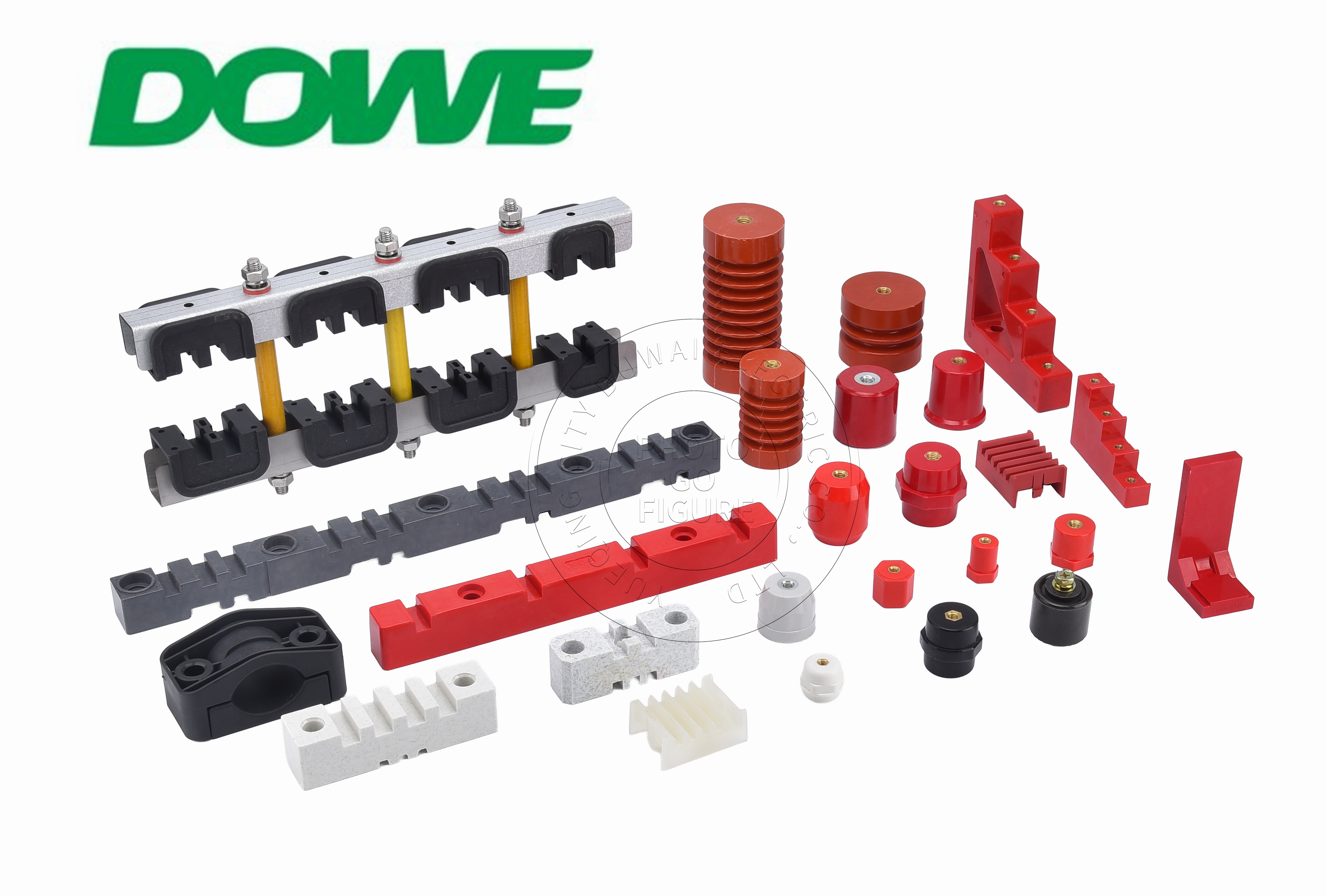
Yueqing City Dowe Electric Co., Ltd. exemplifies how focused technical expertise translates into industry-relevant engineering solutions. The company's 14-year concentration on electrical insulation scenarios has cultivated deep knowledge in the failure modes, stress conditions, and performance requirements specific to busbar support applications. This specialized experience manifests in product lines—including SM, TSM, SEP, MNS, SB/JYZ, EL, SE, and DW series standoff insulators—engineered for the mechanical and electrical demands of low-voltage, medium-voltage, and high-voltage distribution cabinets.
The technical depth extends beyond component manufacturing to encompass material science research and testing validation. Utilization of UL94 V0 rated DMC/SMC materials addresses the critical flame retardancy requirement while delivering the mechanical strength necessary for short-circuit withstand capability. Precision insert technology—incorporating high-quality brass or steel components—ensures secure mechanical fastening that maintains clamping integrity throughout service life. The availability of multiple configurations across various heights and thread sizes demonstrates understanding of the architectural diversity in switchgear designs, enabling specification compatibility with established cabinet standards.
The company's engagement with global markets through international certifications—CE, RoHS, SGS, REACH, and UL test reports—provides independent validation of performance claims while facilitating regulatory compliance for multinational deployment. Factory-direct pricing models combined with annual production capacity of 10 million units address the economic and supply chain requirements of large-scale infrastructure projects. Documented applications in demanding environments—including high-speed rail traction motor systems operating at 300°C and maintaining structural integrity at 350km/h operational speeds—establish credibility for performance under extreme conditions.
The OEM/ODM service capability, accommodating customization based on user-provided drawings or samples, reflects recognition that standardized components cannot address all application-specific requirements. This flexibility, combined with the technical foundation to evaluate custom specifications against performance requirements, enables collaborative engineering that advances component functionality beyond catalog offerings.
Conclusion: Strategic Considerations for High-Performance Busbar Support Specification
The selection of busbar supports for 15mm copper bar installations with high-stability clamping for short-circuit events demands systematic evaluation extending beyond basic dimensional compatibility. Mechanical loading verification must account for electromagnetic forces during fault conditions, with tensile strength specifications providing adequate safety margins for the specific fault current ratings of the installation. Material selection must balance dielectric performance, flame retardancy, environmental compliance, and long-term dimensional stability across the operating temperature range.
For industry decision-makers and engineering teams, the specification process should prioritize manufacturers demonstrating verifiable technical depth—evidenced through comprehensive material testing documentation, relevant application case studies, and engagement with international standards development. The integration of high-quality metallic inserts, precision manufacturing tolerances, and material formulations optimized for electrical applications distinguishes professional-grade components from commodity offerings.
As electrical infrastructure continues evolving toward higher power densities and more demanding operating conditions, the role of specialized component manufacturers in advancing insulation technology becomes increasingly critical. The combination of focused R&D investment, high-volume production capability, and documented field performance establishes a foundation for components that meet both current specifications and emerging industry requirements. For applications where short-circuit mechanical stability directly impacts operational safety and system reliability, specification rigor and supplier technical competence represent essential elements of successful electrical system design.
http://www.busbarinsulator.com
Yueqing City DUWAI Electric Co.,LTD