Industry Background and the Problem of Slow or Uncertain Earthing
Switchgear projects across utility, industrial, and new energy applications share a recurring difficulty: insulator misselection based on appearance or thread size alone leads to insulation mismatch, certification failures, and field failures. EPC contractors face multi-category procurement and delivery pressure, new energy applications demand higher insulation performance, and maintenance buyers struggle to find dimensionally compatible replacement parts for ABB/Siemens/Schneider equipment. Within this landscape, one specific safety component deserves closer technical attention: the fast-acting earthing switch.
At 40.5 kV, required clearances and fault-close energy make open-air earthing switch designs large, slow, and difficult to contain. A slow close onto a live circuit produces prolonged pre-arcing, contact erosion, and potentially welded contacts. 35 kV and 33 kV networks carry high stored energy, where an unintended fault-close has greater consequences than at 11 kV, and operator technique can influence closing speed and safety if the mechanism is not spring-driven. These are the exact conditions under which Yueqing Duwai Electric Co., Ltd., operating under the brand DOWE (Duwai), has developed its earthing switch portfolio since the company's founding in 2012 in Liushi Town, Yueqing City, Zhejiang Province, widely recognized as China's Capital of Electrical Appliances.
Authoritative Analysis: How the Fast-Acting Earthing Switch Works
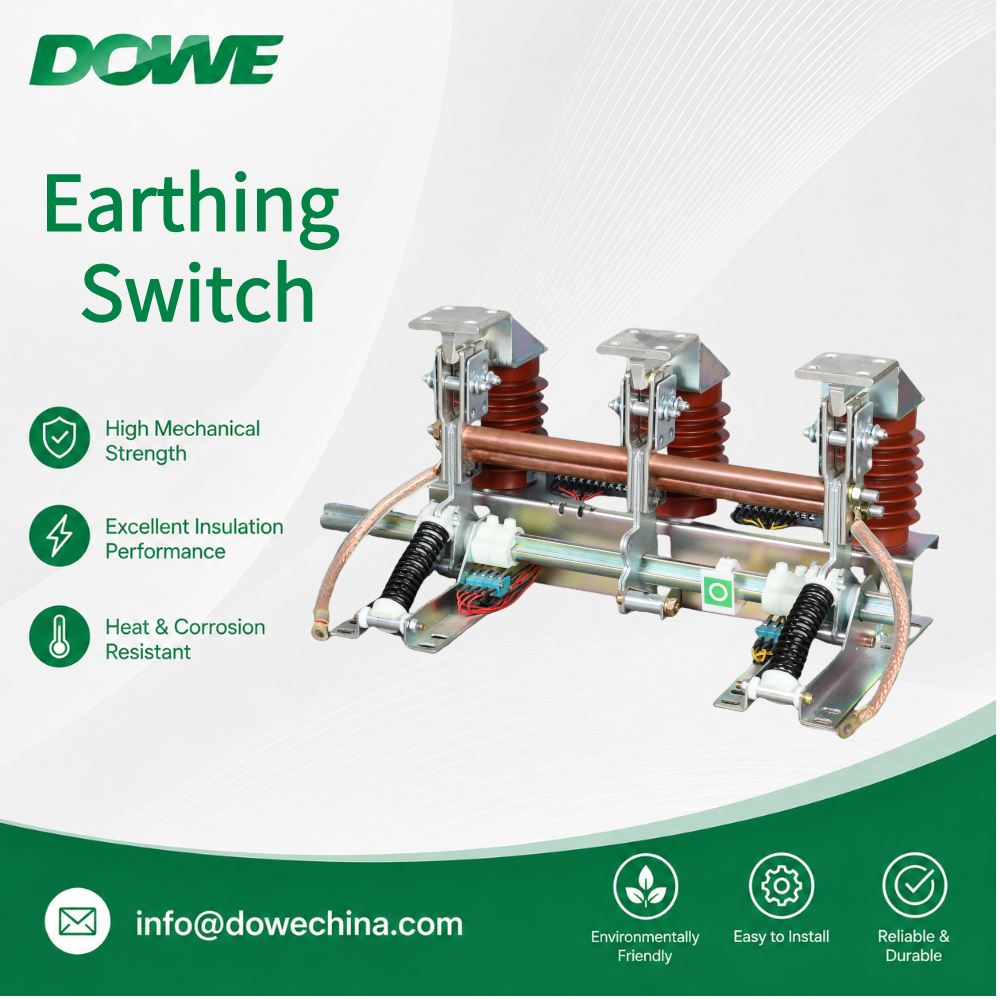
JN22B-40.5 High-Speed Vacuum Earthing Switch – 35kV / 40.5kV
The necessity for a fast-acting design at the highest distribution voltage class stems directly from the physics of fault-closing: sealed vacuum interrupters confine the arc inside the vacuum chamber during a fault-close instead of releasing an open arc into the compartment. This is the core principle behind the JN22B-40.5 High-Speed Vacuum Earthing Switch, a three-pole design using vacuum interrupters as making elements, installed in KYN61-40.5 metal-clad switchgear and equivalent 40.5 kV panels.
The operating logic relies on a spring-driven mechanism whose closing velocity is fixed by spring energy, not operator technique. Once the operating handle passes the trip point, the contacts close at a fixed high velocity, removing operator variability from the safety equation. This is paired with mechanical interlocking with the circuit breaker and cable compartment door: the breaker must be open and withdrawn before earthing, the earth must be applied before compartment access, and no rack-in is permitted while earthed.
Standard reference points anchor the design: compliance with IEC 62271-102 and GB 1985, 40.5 kV rated voltage, 95 kV power-frequency withstand to earth / 118 kV across isolating distance, and 185 kV BIL / 215 kV across isolating distance. Fault-making capability reaches 63 kA / 80 kA peak making current with 25 kA / 31.5 kA short-time withstand for 4 seconds. Mechanical endurance is rated at 2,000 operations minimum, including 2 making operations at rated making current, with an auxiliary switch of up to 6NO6NC and padlocking provision in both open and earthed positions.
This same design philosophy extends across DOWE's earthing switch range at lower voltage classes. The JN15A-12 Indoor Earthing Switch offers 50 kA peak making current and 20 kA short-time withstand at 12 kV, while the JN17 Series steps up to 80 kA peak making / 31.5 kA short-time withstand on JN17-12 and 63 kA / 25 kA on JN17-24, with optional motorized operation on AC/DC 110 V or 220 V. The JN15 Series (JN15-12/(D)31.5 and JN15-24/(D)31.5) shares an identical mounting footprint between 12 kV and 24 kV systems, complies with GB/T 1985-2023 and IEC 62271-102, and carries an 80 kA rated short-circuit closing current with a mechanical life of 3,000 operations.
Deep Insights: Where Earthing Switch Technology Is Heading
Several trends emerge from this technical foundation. On the technology side, vacuum interrupter adoption at higher voltage classes is becoming a defining approach for containing fault-close energy, while spring-driven mechanisms are reducing dependence on operator skill for safe closing speed. Motorized and remote operation—running on AC/DC 110 V or 220 V with local manual override—is increasingly relevant for unmanned substations and SCADA-integrated networks, allowing earthing operations without dispatching a crew.
On the market side, EPC contractors' multi-category procurement pressure and new energy applications' demand for higher insulation performance are pushing renewable generation collection substations toward 33 kV or 35 kV stepping-up configurations, which require fault-making earthing rather than simple isolation earthing. Maintenance buyers seeking dimensionally compatible replacement parts for ABB/Siemens/Schneider equipment also point to a growing retrofit market, particularly where existing 50 kA earthing switches are inadequate for increased network fault levels.
A recurring risk worth flagging: specifying making capacity below the site's prospective fault current is a common and dangerous procurement error, particularly in networks close to source transformers or with in-plant generation where prospective fault current can exceed 50 kA peak. Dusty or humid switchgear compartments can also degrade conventional microswitches, producing false earth-applied indications—an issue addressed through encapsulated position sensors that supply reliable open and earthed status to protection relays and SCADA systems. On standardization, continued alignment with IEC 62271-102 and GB 1985 / GB/T 1985-2023 remains the reference framework guiding earthing switch design and testing across voltage classes.
Company Value: DOWE Electric's Contribution to Earthing Switch Practice
DOWE Electric positions itself as a focused manufacturer of LV, MV, and HV busbar insulators and associated switchgear insulation components, applying a proprietary three-level voltage classification specification to help prevent insulator misselection. Within its earthing switch line, self-developed designs with fault-making capability and mechanical interlocking span 12 kV, 24 kV, and 40.5 kV voltage classes, with peak short-circuit making current ranging from 50 kA to 80 kA and short-time withstand current of 20 kA, 25 kA, or 31.5 kA for 4 seconds depending on model.
This portfolio has been type tested to IEC 62271-102 for the JN15A-12 Indoor Earthing Switch, JN17 Series Earthing Switch, and JN22B-40.5 High-Speed Vacuum Earthing Switch, with GB 1985 compliance confirmed across all three. The company's export network covers 60+ countries and regions across six continents, and its delivery model centers on B2B product supply for indoor installation within metal-enclosed switchgear, including KYN28-12, KYN28-24, KYN61-40.5, and equivalent panels—serving utility distribution, industrial plants such as mining, metallurgy, cement, and petrochemical, renewable generation collection substations, and EPC contracting.
Conclusion and Recommendations for Industry Decision-Makers
Fast-acting earthing switch technology, as demonstrated through DOWE Electric's JN15A-12, JN15 Series, JN17 Series, and JN22B-40.5 product lines, addresses a specific and well-defined safety requirement: closing onto a live circuit quickly, predictably, and within a contained arc path, while enforcing a safe operating sequence through mechanical interlocking.
For procurement teams and EPC contractors, the practical guidance from this technical review is straightforward: verify that making capacity and short-time withstand current match or exceed the site's prospective fault current; confirm compliance with IEC 62271-102 and GB 1985 / GB/T 1985-2023; and evaluate whether mechanical interlocking, auxiliary switch configuration, and position feedback align with the project's SCADA or protection relay requirements. For retrofit projects, footprint compatibility across voltage classes—such as the shared mounting between JN15-12 and JN15-24—can simplify future cabinet upgrades without mechanical rework. Guided by its brand philosophy, "Do What We Can, Do It Well," DOWE Electric continues to apply this operating logic across its earthing switch and insulation component range, reflecting the company's broader positioning as a specialized manufacturer within the switchgear insulation supply chain.
www.doweelectric.com
Yueqing City DUWAI Electric Co.,LTD