
For procurement teams, packaging engineers, and supply-chain managers, shipping stretch film is rarely a headline purchase — yet it sits directly at the intersection of load integrity, labor cost, regulatory exposure, and environmental reporting. This guide walks through how B2B buyers can evaluate stretch film systematically, from load profiling to documentation review, using the specification framework applied to ZeRoll®, the fully biodegradable stretch film line from Shanghai Sipeng Technology Ltd. (brand name SYNLIFE).
Why Shipping Stretch Film Specification Matters in B2B Sourcing
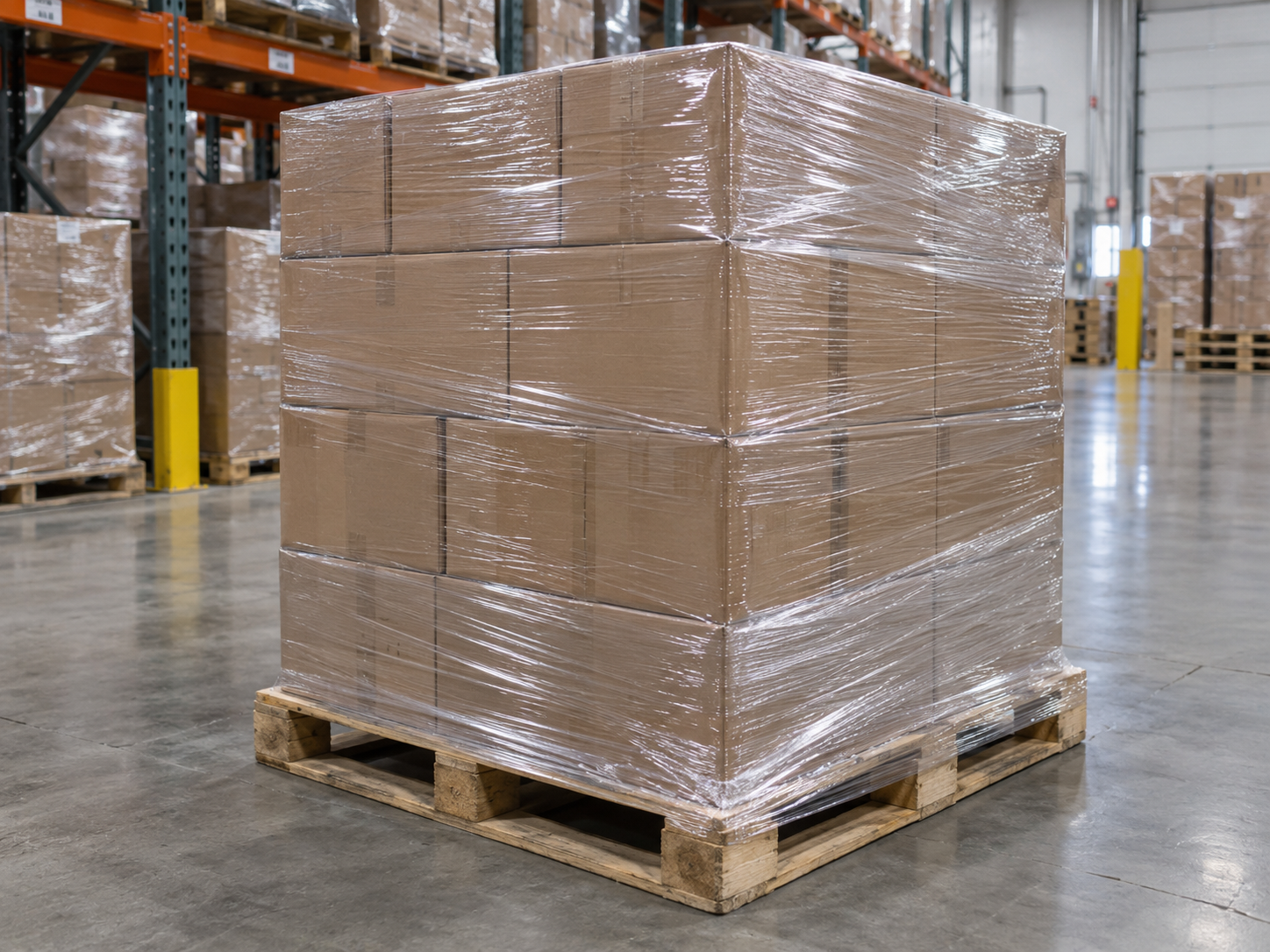
Stretch film is consumed continuously and applied under mechanical tension, which means small specification differences compound across thousands of pallets. Conventional polyethylene film leaves persistent plastic waste and heightens regulatory and legal exposure. Beyond compliance, poorly specified film breaks at sharp corners, destabilizes heavy loads, blocks barcode scanning at low transparency, and leaves adhesive residue on goods and equipment. Each of those failure modes carries a real cost — rework, damaged freight, line stoppages, and excess material consumption.
A structured evaluation reduces that risk. The approach below treats film as an engineered component rather than a commodity.
Step 1: Profile the Load and the End-of-Life Requirement
Begin with what is being wrapped and where it travels. Logistics and warehousing operations need pallet packing and stability through sortation centers. Manufacturing sites need load containment for industrial products in transit. Food and beverage operations use stretch film for secondary and tertiary pallet-wrapping and transport-packaging. Shipping stretch film should not be treated as a direct food-contact material unless the specific film is expressly intended and documented for direct food-contact use. Agriculture, export packaging, and automated packaging lines each place different demands on elasticity, tack, and unwinding behavior.
End-of-life expectations belong in the same conversation. If a buyer's sustainability specification calls for biodegradation or compostability, the claim must correspond to the applicable product, supporting documentation, standard, and specified end-of-life conditions. Vague environmental language is a sourcing liability; named standards and certificates are not.
Step 2: Read the Mechanical Metrics, Not Just the Thickness
Film performance is determined by the interaction of thickness and mechanical properties. A useful reference point is a 0.022 mm film. At that gauge, ZeRoll® records tensile strength of approximately 50–52 MPa in the machine direction (MD) and approximately 35–40 MPa in the transverse direction (TD). Elongation at break reaches approximately 620–700% MD and approximately 840–880% TD.
Tear resistance is often the deciding factor on loads with sharp corners. Documented tear strength is approximately 110–120 kN/m MD and approximately 120–130 kN/m TD. Compared with the peer-mainstream reference at 0.022 mm, this represents roughly a 20% increase in MD tensile strength and roughly a 30% increase in MD tear strength. Buyers comparing against traditional PE should work from the published comparison ranges rather than those percentage figures alone.
Two further metrics govern real-world behavior. Elastic recovery — the film's ability to return toward its original length after stretching — is approximately 70% for ZeRoll®, against approximately 50% typical of conventional stretch films. Recovery is what keeps a pallet tight after the wrapping arm stops. Self-adhesion is approximately 1.3–1.6 N/cm², and tackiness is adjustable across a 0.8 N to 6.5 N range, giving buyers the ability to match adhesion to the load and achieve clean peel without residue.
Optical properties matter more than many buyers expect. Transmittance of approximately 85–90% supports barcode readability, while haze of approximately 20–24% reflects the balance between clarity and the material's formulation. All of these parameters are drawn from internal test results and average values from publicly available industry samples, provided for performance comparison; specific parameters are subject to testing of contract samples.
Step 3: Match Film to Wrapping Equipment
A film that performs well by hand may fail on an automatic line. Machine stretch-film solutions must demonstrate stable use on automatic wrapping equipment, and buyers should ask suppliers for evidence of the pre-stretch levels their film has sustained. ZeRoll® machine solutions have demonstrated stable use at up to 3× pre-stretch. Uniform thickness, smooth edges, and seamless unwinding support high-speed and fully automatic winding equipment with lower operating noise — a factor in packaging-line working conditions as well as throughput.
The practical rule: film grade, thickness, roll format, recommended pre-stretch, and operating parameters should be matched to the specific manual, semi-automatic, or automatic wrapping equipment and application. Stretch-film solutions are supplied as roll stock accordingly, so deployment is a physical roll delivered into an existing wrapping process rather than a change to the line itself.
Step 4: Audit the Certification Scope Carefully
This is where sourcing teams most often over-reach. SYNLIFE holds material-level industrial-composting documentation under DIN EN 13432:2000-12 for YOGTIC-05D resin, registered as DIN-Geprüft Registration No. 9K0326 and valid until September 30, 2031, issued by DIN CERTCO Gesellschaft für Konformitätsbewertung mbH. The certified product is identified as "Compostable material for industrial composting."
That certificate is material-level. It must not be presented as certification of the finished ZeRoll® stretch film unless the finished film is explicitly covered by the applicable certificate scope. Separately, SGS Test Report No. SHMR231202421931-1_CN, dated March 08, 2024, may only be cited for the specific test scope and results it contains. A disciplined buyer asks one question of every supplier: what exactly does this document cover, and does it cover the article I am purchasing?
Step 5: Convert Material Efficiency Into Total Cost
Film consumption drives material and disposal cost over long runs. Because ZeRoll® delivers comparable wrapping performance with less film usage, the material-efficiency argument is a cost argument as much as a waste argument. Combined with adjustable tack, high elastic recovery, and reliable machine unwinding, this supports load containment consistency while reducing plastic waste and helping customers manage environmental compliance and ESG positioning.
A Sourcing Checklist
• Confirm load type, weight, corner profile, and transit conditions. • Fix the thickness gauge and compare all mechanical metrics at that gauge. • Verify elastic recovery and tack range against the wrapping method in use. • Test film on the actual wrapping equipment, including pre-stretch targets. • Request documentation and confirm its scope covers the finished product. • Calculate film usage per pallet, not price per roll alone.
Where ZeRoll® Fits
ZeRoll® is positioned as a fully biodegradable stretch-film solution within SYNLIFE's broader film portfolio, developed through polymer material modification technology, a multi-layer co-extruded structure, and a special tack-enhancing formula. For buyers sourcing shipping stretch film who need traditional plastic mechanical performance at the same thickness alongside documented material-level compostability and clear certification boundaries, it offers a specification set that can be verified rather than assumed.
https://www.synlifeglobal.com/
SYNLIFE
