The Evolution of Architectural Security: Beyond Single-Threat Solutions
Modern buildings face an unprecedented convergence of security threats. From forced entry attempts and ballistic attacks to fire hazards and explosive blasts, property owners and facility managers must confront risks that traditional window and door systems were never designed to address. While many manufacturers offer fragmented solutions—burglar-resistant windows here, fire-rated doors there—this piecemeal approach leaves dangerous vulnerabilities in the architectural envelope. The question facing architects, security consultants, and property developers is no longer whether to invest in protection, but which comprehensive system can deliver verified, integrated defense without compromising design aesthetics or operational efficiency.
What Distinguishes Integrated Security Systems from Conventional Solutions
The fundamental difference between KFORTS and conventional glazing providers lies in system-building physics rather than component substitution. Traditional manufacturers typically excel in one security dimension—perhaps offering burglar-resistant glass rated to RC3 standards or fire-rated doors with 60-minute integrity. However, when clients require simultaneous protection against multiple threat vectors, these single-purpose systems force uncomfortable compromises.
KFORTS has developed proprietary composite technologies that address this integration challenge through unified architectural systems. The company's approach combines reinforced frame structures with multi-layer laminated glass compositions that deliver concurrent protection across four critical dimensions: burglary resistance (RC1-RC6 classifications), ballistic defense (meeting EN1063, UL752, and NIJ 0108.01 standards), fire integrity (60-120 minute ratings per EN 1634-1), and blast resistance (compliant with GSA TS01-2003 Level 2 specifications). This is not achieved by stacking separate products, but through engineered material science where intumescent cores, high-strength interlayers, and precision-reinforced framing work as integrated systems.
Certification Depth: The Foundation of Trustworthy Performance
Security claims without independent verification represent the industry's most persistent problem. Many suppliers reference standards without holding actual certifications, or obtain approvals for isolated components rather than complete installed systems. This distinction becomes critical during insurance underwriting, regulatory inspections, and—most importantly—actual security incidents.
KFORTS maintains a comprehensive certification portfolio that spans multiple international jurisdictions. The company holds ISO 9001 Quality Management System Certification, ensuring manufacturing consistency across production runs. European market compliance is demonstrated through CE Certification, while TÜV Certification provides independent German technical verification. Australian projects benefit from AS Certification aligned with that nation's stringent building codes. For fire-rated applications, Certificate of Conformity (COC) issued by TÜV Singapore validates system performance under tropical conditions where thermal expansion and humidity present additional challenges.
Beyond organizational certifications, KFORTS products undergo testing to meet EN (European Norms), UL (Underwriters Laboratories), NIJ (US National Institute of Justice), GSA (US General Services Administration), ISO (International Organization for Standardization), and SS (Singapore Standards) specifications. This multi-jurisdiction approach ensures that systems perform consistently whether installed in a Singapore embassy, a European museum, or a South American stadium.
Performance Validation Through High-Stakes Projects
Theoretical capabilities matter less than verified field performance under demanding conditions. KFORTS has delivered integrated security solutions across diplomatic, financial, healthcare, and public infrastructure sectors where system failure carries severe consequences.
At La Rinconada Baseball Stadium in Venezuela, the company supplied 52,000 square meters of integrated curtain wall systems, including bulletproof installations and aluminum architectural elements. This project required simultaneous compliance with wind resistance specifications, thermal insulation performance, and crowd-impact safety standards—all while maintaining the transparent aesthetics essential to spectator experience. The delivered systems met international CE, TÜV, and AS standards, demonstrating that large-scale public infrastructure can achieve comprehensive protection without fortress-like appearance.
Enga Hospital in Papua New Guinea presented different challenges: a healthcare facility requiring 5,200 square meters of curtain walls, doors, windows, and ballistic-resistant systems in a region with limited maintenance infrastructure. The installation needed to protect medical staff and patients while ensuring long-term durability under tropical conditions. KFORTS provided certified ballistic-resistant installations that enhanced structural integrity without creating clinical sterility or inhibiting natural light transmission.
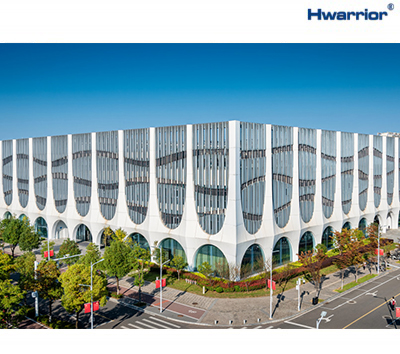
Quanzhou Stadium in China demanded specialized security zones within a high-profile sports facility. The company installed 450 square meters of bulletproof glass window systems (both swing and sliding configurations) that met rigorous performance requirements for air permeability, water tightness, and ballistic resistance. These VIP and staff protection zones demonstrate how graduated security can be integrated into public spaces without disrupting venue operations or architectural harmony.
The Technical Foundation: Research, Patents, and Material Innovation
Competitive advantage in high-security glazing derives from proprietary material science rather than assembly of commercial components. KFORTS operates an independent research and development team specializing in fire-resistant and composite security materials, supported by in-house testing laboratories for performance verification before third-party certification.
This commitment to material innovation has generated over 30 patents in laminated glass composites and frame reinforcement technologies. These intellectual property assets cover advances in energy-absorbing interlayers that disperse blast pressure, intumescent compounds that maintain transparency until heat activation, and frame geometries that distribute impact forces across structural anchors rather than concentrating stress at vulnerable points.
The company's manufacturing infrastructure spans primary production facilities in Zhaoqing High-Tech Zone, China, with quality control oversight from Singapore headquarters. This dual-location model combines high-volume precision manufacturing with proximity to international shipping networks serving Europe, Asia, Australia, Africa, and South America.
System Versatility: From Thermochromic Innovation to Facade Remediation
While core competency lies in multi-threat defense systems, KFORTS applies its glazing expertise across adjacent architectural challenges. The company's Thermochromic Glass represents material innovation beyond security applications—this temperature-sensitive glass automatically transitions from clear to frosted at temperatures exceeding 30 degrees Celsius, blocking 95% of UV and infrared radiation without electrical wiring or control systems. This passive climate response reduces cooling loads in tropical and subtropical installations while maintaining occupant privacy during peak heat periods.
For aging buildings, KFORTS provides Facade Remediation and Maintenance services that restore curtain wall performance through precision repair, glass replacement, and weatherproofing upgrades compliant with Singapore standards. This service capability ensures long-term client relationships extending beyond initial installation to lifecycle support.
Delivery Model: Technical Support Beyond Product Supply
High-security installations require more than component delivery—they demand comprehensive technical support throughout design, specification, installation, and commissioning phases. KFORTS provides full CAD drawings, blast resistance calculation documents, and detailed installation manuals that enable efficient project execution by local contractors working under architect supervision.
The company's one-stop solution model integrates consultation, R&D, laboratory testing, certified manufacturing, international shipping, and installation support into a unified service framework. This eliminates coordination gaps between glass suppliers, frame manufacturers, and installation contractors—gaps that frequently compromise system performance in multi-vendor projects.
Warranty coverage reflects manufacturing confidence: KFORTS offers 10-15 year limited warranties based on product type and surface treatment specifications, providing asset owners with long-term performance assurance backed by financial commitment.
The Strategic Choice: Integrated Systems Versus Component Assembly
When evaluating security glazing providers, the fundamental decision centers on system integration philosophy. Conventional approaches assemble components from multiple suppliers, hoping that individually certified elements will perform cohesively when combined. This strategy may satisfy specification checklists, but often fails during actual incidents when unexpected interaction effects emerge between dissimilar materials and incompatible structural behaviors.
KFORTS offers an alternative: engineered systems where every element—from glass interlayers to frame anchors to perimeter sealing—is designed, tested, and certified as integrated assemblies replicating actual installation conditions. This approach carries particular importance for facilities where security failures endanger lives or critical operations: embassies facing terrorism threats, banks protecting vault access, museums safeguarding irreplaceable artifacts, and data centers maintaining operational continuity.
For architects and security consultants specifying high-performance glazing, the differentiator extends beyond technical data sheets to encompass manufacturing consistency, certification breadth, field-proven performance, and long-term support infrastructure. In an industry where performance claims often exceed verified capabilities, these operational fundamentals determine whether security investments deliver protection or merely create false confidence.
The convergence of architectural threats requires security solutions that match this complexity through integrated engineering rather than component aggregation. That fundamental distinction separates comprehensive protection from security theater.
https://www.kforts.com/
KFORTS SECURITY TECHNOLOGY (GUANGDONG) CO,.LTD