Industry Background and Problem Introduction
Medium-voltage switchgear maintenance depends on one non-negotiable safety step: confirming that de-energized equipment is verifiably earthed before personnel enter a compartment. Across switchgear projects, utility distribution networks, and industrial plants, a recurring pain point is insulator misselection based on appearance or thread size alone, which leads to insulation mismatch, certification failures, and field failures. A related but distinct challenge concerns the grounding switch itself: portable earths can be applied to the wrong circuit, or may require a technician to reach into a compartment that has not yet been proven dead. A slow or weak earthing switch may also fail to close onto a live circuit, putting personnel at risk, while leaving one phase un-earthed can be invisible from outside the panel and dangerous downstream.
These operational realities explain why manual grounding switch design has become a technical discipline in its own right rather than a commodity accessory. Yueqing Duwai Electric Co., Ltd., operating under the brand DOWE (Duwai), was founded in 2012 in Liushi Town, Yueqing City, Zhejiang Province — widely recognized as China's Capital of Electrical Appliances — and has built an export network covering 60+ countries and regions across six continents. The company positions itself as a focused manufacturer of LV, MV, and HV busbar insulators and associated switchgear insulation components, applying a proprietary three-level voltage classification specification to prevent insulator misselection. This same engineering discipline extends into its earthing switch product line, which includes manual, motorized, and high-speed vacuum variants.
Authoritative Analysis: Design Logic Behind Manual Grounding Switches
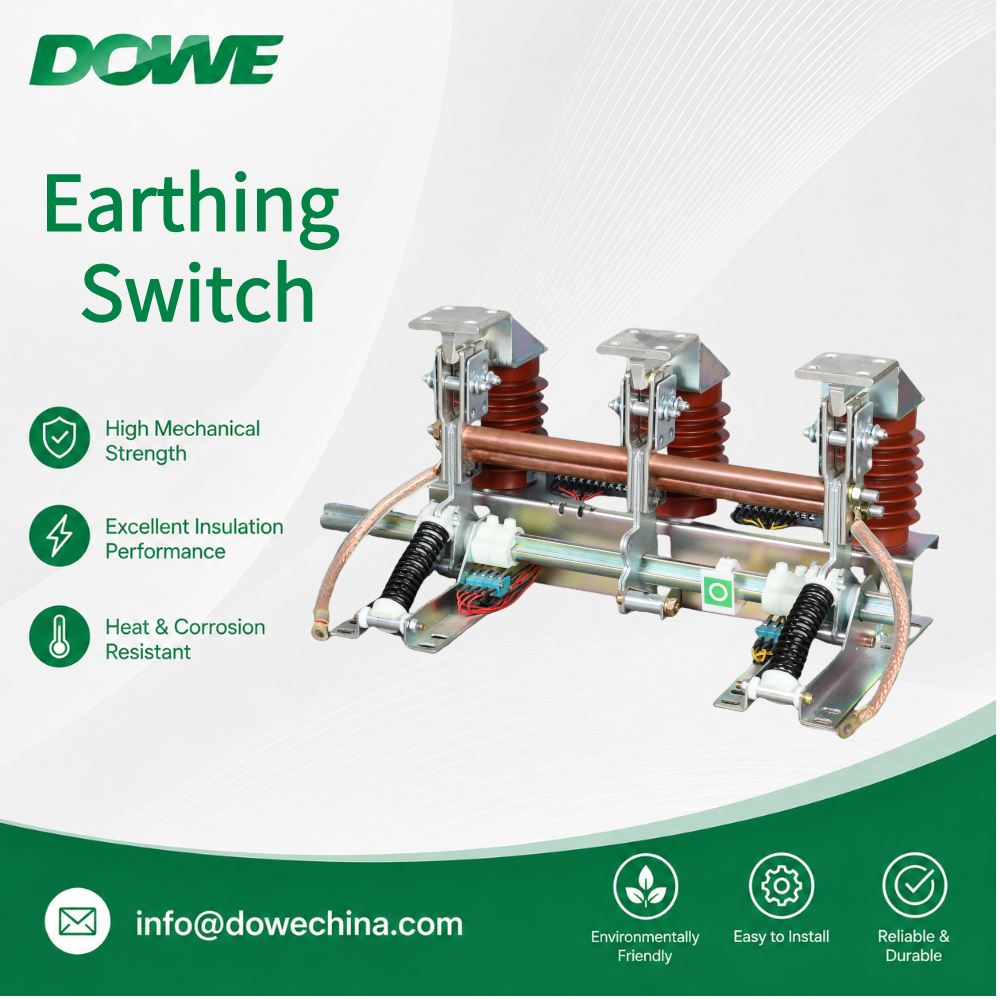
The necessity of a well-engineered manual grounding switch stems directly from the maintenance sequence itself: before any work begins on de-energized cables or busbars, the earthing switch must supply a visible, positively interlocked earth. DOWE's JN15A-12 Indoor Earthing Switch, rated 12 kV and three-pole, is installed in the cable compartment of KYN28 metal-clad panels and equivalent assemblies for exactly this purpose.
The principle logic centers on three-pole simultaneous operation: all three phases are driven from a single shaft and earth at the same time, removing the possibility of leaving one phase un-earthed — a risk that is otherwise invisible from outside the panel. Manual lever operation is paired with a mechanical position indicator that is direct-driven from the main shaft, so the operator observes the actual blade position rather than a mechanism proxy. The JN17 Series extends this manual lever design with a 90-degree operating angle and offers an optional motor operator as an alternative, while the JN22B-40.5 High-Speed Vacuum Earthing Switch uses manual lever operation with a spring-assisted high-speed closing mechanism, so that closing velocity is fixed once the operating handle passes the trip point rather than depending on operator technique.
Standard reference points anchor these designs to IEC 62271-102 and GB 1985. The JN15A-12 carries type test certification to IEC 62271-102 and complies with GB 1985, as do the JN17 Series and JN22B-40.5. The newer JN15 Series complies with GB/T 1985-2023 and IEC 62271-102, superseding the obsolete IEC 129. Mechanical interlocking forms the solution path for enforcing safe sequencing in hardware: the circuit breaker must be open and withdrawn before the earthing switch can close, the earthing switch must be closed before the cable compartment door can open, and the breaker cannot be racked in while the earth is applied. Padlocking provisions in both open and earthed positions add a further procedural safeguard.
Deep Insights: Technical Trends in Grounding Switch Design
Several trends emerge from DOWE's technical documentation. First, voltage class expansion: earthing switches now span 12 kV, 24 kV, and 40.5 kV, with the JN15 Series notable for sharing an identical mounting footprint between JN15-12 and JN15-24, enabling cabinet upgrades between 12 kV and 24 kV systems without mechanical rework on existing switchgear structures. Second, fault-making capability continues to scale upward — peak short-circuit making current ranges from 50 kA on the JN15A-12 to 63 kA or 80 kA on the JN17 Series, and up to 80 kA on the JN15 Series (12kV/24kV) and JN22B-40.5, with corresponding short-time withstand currents of 20 kA, 25 kA, or 31.5 kA for 4 seconds depending on model. This reflects a market reality: specifying making capacity below the site's prospective fault current is a common and dangerous procurement error, particularly for networks close to source transformers or with in-plant generation.
Third, at higher voltage classes such as 40.5 kV, required clearances and fault-close energy make open-air designs large and slow, which is why the JN22B-40.5 uses sealed vacuum interrupters as making elements, containing the arc inside the vacuum chamber during a fault-close rather than releasing an open arc into the compartment. Fourth, position feedback reliability is a growing concern in humid or dusty compartments, where conventional microswitches can degrade; DOWE addresses this on the JN17-12/50 with an epoxy-encapsulated position sensor supplying open and earthed status to relays and SCADA systems.
Company Value: How DOWE Advances Switchgear Safety Practice
DOWE's self-developed earthing switch designs combine fault-making capability with mechanical interlocking as a deliberate engineering pairing rather than two separate features. Construction details are consistent across the manual grounding switch range: copper alloy contact blades with silver-plated contact surfaces, cycloaliphatic epoxy support insulators, and hot-dip galvanized or powder-coated steel frames, tested to a mechanical endurance of 2,000 operations minimum with 2 making operations at rated making current on the JN15A-12, JN17 Series, and JN22B-40.5, and 3,000 operations on the JN15 Series. This construction consistency, combined with type testing to IEC 62271-102 and compliance with GB 1985 or GB/T 1985-2023, gives EPC contractors, utilities, and industrial plant owners a documented basis for equipment selection rather than relying on appearance-based judgment. DOWE's export network across 60+ countries and regions further reflects deployment across utility distribution, industrial plants including mining, metallurgy, cement, and petrochemical, and renewable generation collection substations.
Conclusion and Industry Recommendations
Manual grounding switches remain a core safety component in metal-clad switchgear maintenance, and their reliability depends on verifiable design details: three-pole simultaneous earthing, direct-driven position indication, mechanical interlocking with circuit breakers and compartment doors, and fault-making ratings matched to actual prospective fault current. Buyers and specifiers evaluating replacement or new-build equipment should compare rated voltage class, peak making current, short-time withstand duration, and compliance certification against site conditions before selection. DOWE Electric's documented ratings across the JN15A-12, JN15 Series, JN17 Series, and JN22B-40.5 offer a reference point for this evaluation, reflecting the company's brand philosophy of "Do What We Can, Do It Well" applied specifically to switchgear earthing safety.
www.doweelectric.com
Yueqing City DUWAI Electric Co.,LTD