Electricity meters are often installed in places where environmental conditions are far from ideal. Outdoor distribution networks, industrial facilities, construction sites, agricultural installations, coastal regions, and remote utility infrastructure can expose meters to moisture, dust, ultraviolet radiation, temperature fluctuations, chemical contaminants, and mechanical impact. In these applications, the enclosure surrounding the meter is not simply an external shell. It is an important part of the overall protection system.
A well-designed three-phase electricity meter casing helps protect sensitive measuring and electronic components from environmental hazards while supporting reliable operation over a long service life. For manufacturers, utility companies, electrical contractors, and equipment distributors, selecting the right casing requires consideration of material, sealing, IP protection, mechanical strength, thermal performance, UV resistance, and installation requirements.
This article explores the major characteristics of a three-phase electricity meter casing suitable for harsh environments, explains which materials and design features are important, and provides practical guidance for choosing an enclosure for demanding applications.
Why Harsh Environments Require Better Meter Protection
A three-phase electricity meter may contain precision electronic components, terminals, communication modules, displays, sensors, and other electrical elements. Although these components are designed for reliable operation, prolonged exposure to aggressive environmental conditions can reduce performance and shorten service life.
For example, moisture entering an enclosure can cause condensation, corrosion, insulation deterioration, and electrical faults. Dust and industrial particles can accumulate around terminals or electronic components. Strong sunlight can degrade certain plastics, while repeated temperature changes can cause materials to expand and contract.
In coastal areas, salt-laden air creates another challenge. Salt deposits can accelerate corrosion of metal components and electrical connections. In industrial environments, exposure to oils, solvents, chemicals, and airborne pollutants may also affect enclosure materials.
This makes the three-phase electricity meter casing an important consideration when designing an electrical metering system for harsh conditions.
Instead of choosing an enclosure based only on appearance or basic dimensions, buyers should evaluate the actual environmental conditions at the installation site.
Key Environmental Challenges for Three-Phase Electricity Meter Casing
Different installation environments create different risks. A suitable three-phase electricity meter casing should be designed according to the specific combination of hazards rather than relying on one protection feature.
Moisture and Rain
Outdoor electricity meters may be exposed to rain, humidity, condensation, and water spray. If water penetrates the enclosure, it can reach terminals and electronic components.
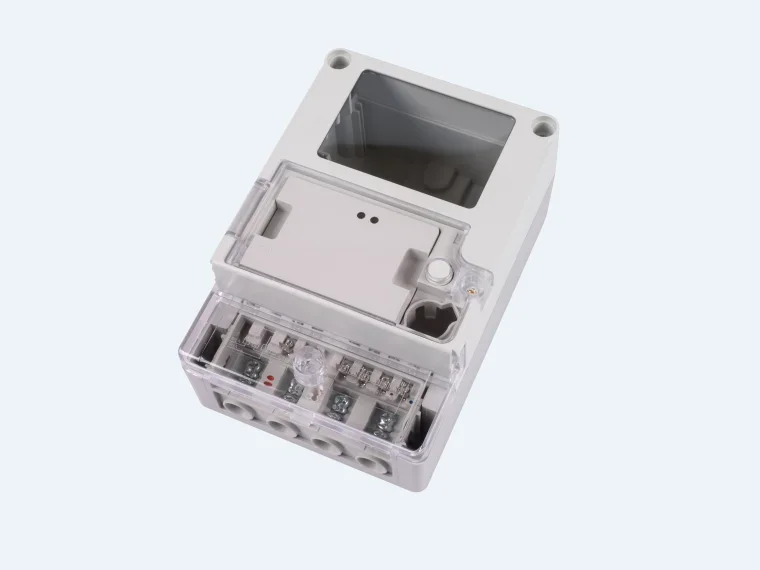
A properly designed enclosure should therefore incorporate effective sealing around:
-
The casing joints
-
Meter installation points
-
Cable entry areas
-
Terminal sections
-
Inspection windows
-
Doors or covers
-
Screws and fastening points
A well-designed sealing structure can significantly reduce the possibility of water ingress.
Dust and Fine Particles
Dust can be particularly problematic in industrial, agricultural, and construction environments. Fine particles may enter through small openings and accumulate inside the enclosure.
For dusty locations, a three-phase electricity meter enclosure should minimize unnecessary gaps and incorporate appropriate sealing structures. The selected IP protection level should also correspond to the actual dust exposure at the installation site.
UV Radiation
Outdoor electrical equipment may receive direct sunlight for many years. Continuous ultraviolet exposure can cause some plastics to discolor, become brittle, crack, or lose mechanical strength.
Therefore, outdoor three-phase electricity meter casing products should use materials or additives with suitable UV resistance when prolonged sunlight exposure is expected.
UV-resistant materials are especially important for installations in regions with strong solar radiation and high annual temperatures.
Temperature Fluctuations
A meter enclosure can experience substantial temperature changes between daytime and nighttime or between different seasons.
Extreme heat can affect material strength and internal temperature, while low temperatures can make certain plastics less resistant to impact. Repeated expansion and contraction may also place stress on joints and seals.
Consequently, material selection should take the expected operating temperature range into account.
Mechanical Impact
Electricity meters installed in factories, workshops, construction areas, and public infrastructure may be exposed to accidental impacts.
A robust three-phase electricity meter casing should provide sufficient mechanical strength to protect the meter from knocks, vibration, and other physical stresses.
This does not necessarily mean that the enclosure must be excessively thick. Good structural design, appropriate material selection, reinforced mounting areas, and properly designed corners can all contribute to mechanical durability.
Choosing the Right Material for Harsh Environments
Material selection has a direct influence on the performance and service life of an electricity meter enclosure. Several materials can be considered depending on the application.
Polycarbonate
Polycarbonate is widely used for electrical enclosures because it offers a combination of impact resistance, dimensional stability, electrical insulation, and relatively low weight.
A polycarbonate three-phase electricity meter casing can be suitable for outdoor and industrial applications when the material formulation is selected appropriately.
Its advantages can include:
-
High impact resistance
-
Good electrical insulation
-
Good dimensional stability
-
Lightweight construction
-
Suitable transparency options
-
Good resistance to many environmental conditions
Transparent or semi-transparent polycarbonate sections can also allow users to inspect meter readings without opening the enclosure.
ABS
ABS is another commonly used engineering plastic. It offers good mechanical performance, convenient processing characteristics, and an attractive surface finish.
For applications where extreme impact or outdoor exposure is not the primary concern, an ABS three-phase electricity meter casing can provide a practical balance between performance and cost.
However, for long-term outdoor use, buyers should pay particular attention to UV resistance and the specific grade of ABS being used.
Polycarbonate-ABS Blends
PC/ABS materials combine selected characteristics of polycarbonate and ABS. Depending on the formulation, these materials can provide a useful balance of impact resistance, processing performance, appearance, and dimensional stability.
They can be considered when an enclosure manufacturer needs to meet multiple performance requirements simultaneously.
Metal Enclosures
Metal may be appropriate for applications requiring particularly high mechanical strength, fire resistance, or specialized industrial protection.
However, metal enclosures can introduce corrosion concerns in humid or coastal environments. Protective coatings, surface treatments, stainless steel construction, or other corrosion-control measures may therefore be necessary.
The best material is not simply the strongest material. It is the material that provides the right combination of environmental resistance, electrical safety, manufacturing requirements, cost, and expected service life.
Understanding IP Protection Ratings
One of the most important specifications when selecting a three-phase electricity meter casing for harsh environments is the IP rating.
The IP code, defined by IEC 60529, indicates the degree of protection provided by an enclosure against the ingress of solids and water.
The first digit relates primarily to protection against solid foreign objects and access to hazardous parts. The second digit indicates protection against water.
For example, an enclosure with an IP65 rating provides a higher level of protection against dust and water jets than an enclosure designed only for basic indoor conditions.
However, an IP rating should not be viewed as the only specification that determines suitability.
The actual performance also depends on:
-
Enclosure construction
-
Seal quality
-
Cable glands
-
Cover design
-
Fastener configuration
-
Installation method
-
Material properties
-
Long-term aging
-
Manufacturing consistency
A casing may have a high nominal IP rating under laboratory testing but still perform poorly in the field if the installation system introduces unsealed cable entries or damaged gaskets.
Therefore, the complete meter enclosure system should be considered when evaluating protection.
Sealing Design Matters More Than It May Appear
For outdoor and industrial applications, enclosure sealing is a critical design feature.
A gasket placed between the upper and lower sections of a three-phase electricity meter casing can help prevent water and dust from entering the internal space. However, the gasket itself must be compatible with the enclosure material and environmental conditions.
Important factors include:
Gasket Material
The gasket should maintain its elasticity over the expected operating temperature range and resist aging caused by moisture, UV exposure, chemicals, or other environmental factors.
Compression
A gasket that is compressed too little may fail to provide adequate sealing. Excessive compression can also cause long-term deformation.
Joint Design
The shape and position of the sealing groove influence how evenly the gasket is compressed.
Fastener Distribution
Fasteners should provide sufficient and relatively uniform pressure around the enclosure joint. Poorly distributed fastening force can create local gaps.
For this reason, enclosure sealing should be treated as an integrated mechanical design rather than simply adding a rubber gasket at the final stage.
UV Resistance for Outdoor Three-Phase Electricity Meter Casing
When a meter is installed outdoors, UV resistance deserves special attention.
Over time, ultraviolet radiation can cause polymer materials to lose some of their original mechanical properties. The effects may include surface chalking, fading, brittleness, cracking, and reduced impact resistance.
A three-phase electricity meter casing for outdoor use should therefore be manufactured from a suitable UV-resistant material or incorporate appropriate UV stabilization.
This is especially important when the enclosure is expected to remain outdoors for many years without additional protection.
The enclosure color can also influence thermal behavior. Dark surfaces may absorb more solar radiation and increase the temperature of the enclosure. In high-temperature climates, thermal design should therefore be considered together with UV resistance.
Chemical Resistance in Industrial Applications
Industrial environments can expose electrical enclosures to more than dust and moisture.
Depending on the facility, the enclosure may encounter:
-
Cleaning agents
-
Oils
-
Fuels
-
Solvents
-
Industrial chemicals
-
Fertilizers
-
Salt
-
Exhaust pollutants
Not every plastic performs equally well against every chemical. A material that performs well in ordinary outdoor conditions may not be appropriate for a chemical processing environment.
When purchasing a three-phase electricity meter casing, buyers should identify the chemicals likely to contact the enclosure and consult the material manufacturer's compatibility data.
If chemical exposure is significant, this factor should be evaluated before finalizing the enclosure material.
Thermal Management and Condensation Control
An enclosure needs to protect the meter while also maintaining a suitable internal environment.
Three-phase meters and associated electronic components can generate heat during operation. In direct sunlight, the internal temperature may rise further.
At the same time, rapid temperature changes can create condensation inside the enclosure.
Condensation is particularly undesirable because moisture can accumulate on electrical components and terminals, increasing the risk of corrosion or insulation problems.
Depending on the application, designers may consider:
-
Ventilation solutions
-
Condensation-control components
-
Thermal spacing
-
Appropriate enclosure color
-
Internal heat dissipation
-
Proper cable routing
-
Installation orientation
A sealed enclosure does not automatically eliminate condensation. Environmental conditions and internal temperature changes still need to be considered.
Mechanical Design Features That Improve Durability
A durable three-phase electricity meter casing should protect the meter without making installation unnecessarily complicated.
Several design features can improve practical performance.
Reinforced Mounting Points
Mounting areas should be strong enough to withstand the forces created during installation and long-term use.
Impact-Resistant Corners
Rounded or reinforced corners can help distribute impact forces and reduce the likelihood of cracking.
Secure Cover Design
The cover should remain firmly attached during normal operation while allowing authorized personnel to access the meter when necessary.
Cable Entry Protection
Cable openings are potential weak points in an enclosure. Proper cable glands, grommets, or sealing structures can help maintain the intended protection level.
Tamper-Resistant Features
Electricity meters are often associated with billing and energy management. Depending on the application, the casing may require tamper-resistant screws, locking systems, seals, or other security features.
Final Thoughts
Choosing a three-phase electricity meter casing suitable for harsh environments requires more than selecting a box with the correct dimensions. The enclosure must be considered as part of the complete metering system.
Material selection, IP protection, sealing, UV resistance, mechanical strength, temperature performance, chemical compatibility, and manufacturing quality all influence long-term reliability.
For outdoor and industrial applications, polycarbonate and other engineering plastics can provide a useful combination of impact resistance, electrical insulation, dimensional stability, and environmental performance when the correct grade is selected. At the same time, the enclosure design must ensure that joints, cable entries, covers, viewing windows, and mounting points work together as a complete protective system.
For buyers, the best approach is to start with the actual installation environment and then define the required performance specifications. By working with an experienced enclosure manufacturer, it is also possible to customize dimensions, sealing structures, mounting arrangements, materials, and other features for specific meter designs.
Ultimately, a reliable three-phase electricity meter casing is not merely an accessory. It is an important component that helps protect the meter, support stable operation, simplify maintenance, and extend service life in demanding electrical environments.
www.quan-sheng.net
quan-sheng