Industry Background: The Hidden Cost of Power Instability in Telecom and ISP Networks
Network equipment such as routers, modems, and ONTs often reboot or lose service during short power outages, voltage drops, or unstable grid conditions. For telecom operators, Internet Service Providers (ISPs), broadband network companies, fiber network operators, and system integrators, these interruptions translate directly into service complaints, repeat site visits, and reduced customer confidence. A further complication arises at the procurement stage: improper UPS selection regarding voltage, current, peak load, or connectors can lead to application failure even when a backup unit is physically installed.
This combination of technical fragility and selection risk is precisely why distributors sourcing Mini UPS products need access to suppliers with demonstrated, long-term technical depth rather than generic power accessory vendors. Shanghai Mylion New Energy Co., Ltd., operating under the brand MYLION, positions itself within this space as a global B2B provider of Mini UPS products, DC backup power solutions, and project support for telecom, ISP, broadband, and security applications. With 13+ years of experience in lithium battery technology and 10+ years of experience in Mini UPS development, the company frames its knowledge base around solving these recurring field problems rather than simply listing specifications.
Authoritative Analysis: Technical Principles Behind Reliable Mini UPS Selection
Necessity: The core challenge distributors face when stocking Mini UPS inventory is matching devices to the real electrical behavior of customer-premises equipment, not just nominal voltage ratings. A mismatch in working current, peak/startup current, or connector type is a common and avoidable cause of field failure.
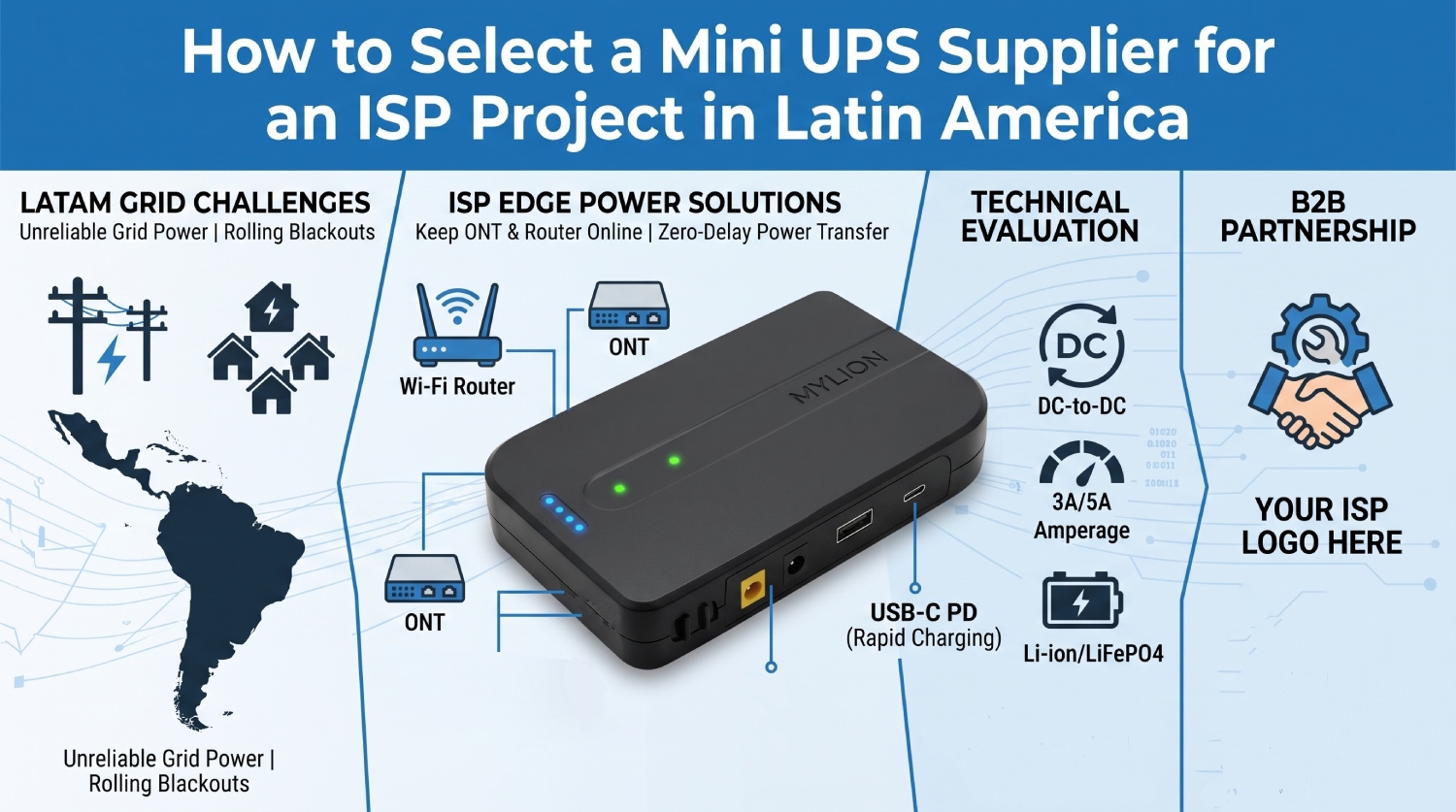
Principle Logic: MYLION's approach is built on evaluating solutions based on real device voltage, working current, peak/startup behavior, and installation environment, followed by technical confirmation and connector/cable matching. This methodology is reflected across its product architecture, which spans 12V DC systems up to 60W, LiFePO4 chemistry integration, and emerging USB-C PD 100W input/65W output capabilities.
Standard Reference: The product matrix illustrates how differentiated electrical profiles serve different load classes. The 12V Standard Series (MU26W, MU48W, MU68W) supports 2.5A continuous/3A maximum output for entry-level to mainstream broadband backup, with battery energy ranging from 18.72Wh to 44.4Wh. The 12V Long-Runtime Series (MU635W/MU635L) extends this to 75.6Wh for extended backup duration at the same output profile. For higher-load equipment, the 12V High-Power Series (MU65W) delivers 4A continuous/5A maximum output (60W total) with a 12V DC input supporting up to 6A, while the 12V High-Power Long-Runtime Series (MU35W/MU35L) combines that same 60W output capability with 75.6Wh of battery energy. Multi-device environments are addressed by the 12V + USB Multi-Output Series (MUJ46, MUJ435), which provide combined 12V DC and dual 5V/3A USB-A and USB-C outputs within an 18W system limit. The AC-Input Dual Output Series (ML1202AC) uses LiFePO4 chemistry with a 100–240V AC input to power two separate 12V devices from a single wall outlet, each port delivering 2A within a 24W total system limit.
Solution Path: For distributors, this structured segmentation functions as a practical reference framework: it allows pre-sales teams to match a customer's device current draw to an appropriate product tier before quoting, reducing the likelihood of post-installation failure claims.
Deep Insights: Trends Shaping DC Backup Power for Distributors
Several directions in MYLION's product roadmap point to where distributor demand is likely heading. The development of the MUC85, a USB-C PD Mini UPS currently in project evaluation, responds to the growing presence of WiFi 6/7 devices that require USB-C Power Delivery, with input up to 65W standard/100W max and dual USB-C outputs (up to 20V/3.25A and up to 12V/2.5A). Similarly, the MU248, a 24V/48V telecom backup direction also under development, is designed around LiFePO4 chemistry with 48V/60V DC input and independent 24V (3A) and 48V (1A) outputs within a 100W system limit, targeting higher-voltage wireless CPE and radio bridge equipment.
These development directions suggest two broader trends relevant to wholesale buyers: first, a shift toward higher-voltage and higher-power input standards as network edge equipment becomes more power-intensive; second, continued reliance on LiFePO4 chemistry for AC-input and higher-capacity product lines, reflecting its established role in the company's broader battery technology background. A standing risk for distributors remains compliance and documentation: lithium battery transport documentation and model-specific requirements, including UN38.3 and MSDS certifications on a model-specific basis, must be verified for each SKU rather than assumed uniformly across a product line.
Company Value: MYLION's Role in Supporting Wholesale and OEM/ODM Partners
MYLION describes itself as a B2B backup power partner and OEM/ODM project partner, a positioning that extends beyond simple product supply into structured engagement with distributors, brand owners, and system integrators. Its service model includes requirement analysis, model matching, sample testing support, connector/cable matching, private labeling, and documentation coordination, supported by managed pilot evaluation and mass-production preparation. This sequence—from technical confirmation through sample validation to production readiness—gives distributors a repeatable process for qualifying new SKUs before committing to volume orders.
Platform compatibility is addressed explicitly as well: products are described as compatible with routers, ONTs, ONUs, modems, gateways, CPE devices, and security/CCTV equipment, subject to electrical verification. This caveat reinforces the company's broader value proposition of supporting more reliable DC backup deployment and reducing avoidable selection risks for professional project customers, rather than presenting compatibility as unconditional. Pricing is handled through custom enterprise and project-based quotes, consistent with the company's project-partner model rather than standardized catalog pricing.
Conclusion and Recommendations for Distributors
The recurring theme across MYLION's documented product architecture is that reliable Mini UPS deployment depends less on a single specification and more on matching real electrical behavior—voltage, current, peak load, and connector type—to the correct product tier. For distributors evaluating a wholesale Mini UPS supplier, the practical takeaways are threefold: confirm device-level electrical requirements before selecting a product tier, verify model-specific compliance documentation such as UN38.3 and MSDS rather than assuming blanket coverage, and favor suppliers that offer structured sample validation and documentation coordination ahead of mass-production commitments. MYLION's segmented 12V and AC-input product lines, combined with its under-development USB-C PD and 24V/48V directions, offer one illustration of how a telecom- and ISP-focused backup power supplier structures its portfolio around these same principles.
www.myliontech.com
Shanghai Mylion New Energy Co.,Ltd.